It could be the start of a good riddle: How many synapses of the brain does it take to figure out how to improve fuel efficiency? If you’re Andreas Malikopoulos, Energy and Transportation Science Division researcher and Alvin M. Weinberg Fellow, the answer is far from simple.
In late 2010, Malikopoulos joined ETSD with an interest in developing the information and decision science (IDS) thrust area and a desire to uncover how the brain works through reverse engineering. According to Malikopoulos, reverse engineering the brain can reveal its secret code and functions – keys to developing decision-making models that enable the creation of thinking machines capable of emulating human intelligence. The intention is to weave ideas from statistical signal processing, stochastic control, and information theory into new ones drawn from neuroscience, statistical learning theory, and game theory in order to create models that can represent four key functions of the brain–perception, attention, learning, and intelligence.
“Outcomes from understanding more about the brain could greatly impact and yield great increases in fuel and energy efficiency. We could also apply this knowledge in a number of other areas such as manufacturing, safety, healthcare and even finance,” Malikopoulos said.
His research to date has largely focused on issues related to vehicle fuel efficiency. Malikopoulos can implement computational intelligence models—based on data gleaned from reverse engineering of certain brain functionality— that can predict future behavior based on the user’s driving habits and patterns and adjust accordingly.
“This allows the vehicle to learn the driver, just like the brain allows us to learn based on past experience. As the vehicle gets smarter, its performance becomes more efficient to, for example, optimize miles per gallon,” he explained.
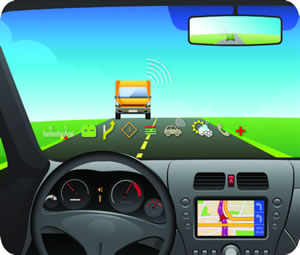
A more recent IDS research effort is a project called iVEHICLE (intelligent VEhicle and HIghway Communication Leverage for Efficiency) that involves an optimization framework and control algorithms that will allow vehicles to “talk” to each other and with advanced information systems, sharing information so conventional vehicles will learn how to optimize fuel efficiency and plug-in HEVs will learn how to optimize their overall range.
Prior to joining ORNL, Andreas worked for General Motors Global Research & Development conducting research in the area of stochastic control and hybrid systems with an emphasis on applications to advanced propulsion systems. As he seeks new findings at the intersection of neuroscience and engineering, he is connecting with DOE and industry representatives who are looking into opportunities to further explore the potential benefits of this research.
For more information of Andreas’ research, see the following articles that were published in Green Car Congress in recent months:
http://www.greencarcongress.com/2013/01/aam-20130104.html
http://www.greencarcongress.com/2012/10/malikopoulos-20121003.html
http://www.greencarcongress.com/2012/05/malikopoulos-20120524.html