While palladium, a common catalyst, oxidizes easily, it has now been shown that palladium films grown on ruthenium are surprisingly inert to
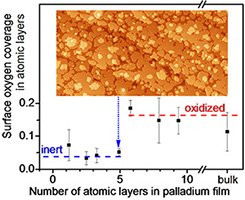
oxidation when they are thinner than six atomic layers.
The ability to control the binding strength of molecules to metal surfaces is fundamental to the design of materials for sustainable energy applications. Catalyst efficiency and selectivity depends sensitively on the strength of such interactions: too weak and the catalyst cannot capture enough molecules to react; too strong and the reaction products do not desorb, blocking further reactions.
Catalyst design often relies on increasing the interaction strength on relatively non-reactive materials by introducing active sites on a surface; the opposite approach, demonstrated in this work, is much harder to achieve. A theoretical analysis reveals that the chemical nobility observed here is driven by changes in specific metal orbitals due to finite size effects. The novel ability to decrease the interaction strength on a reactive metal, and the insight into its orbital-specific origins, will aid in designing better materials for energy-efficient processes.
Xiangshi Yin, Valentino R. Cooper, Hanno H. Weitering, and Paul C. Snijders, “Surface chemical reactivity of ultrathin Pd(111) films on Ru(0001): Importance of orbital symmetry in the application of the d-band model,” J. Phys. Chem. C 119, 23495 (2015). DOI: 10.1021/acs.jpcc.5b06653
Related Researchers