Characterizing Performance of Nanostructured Alloys for Extreme Environments
Share
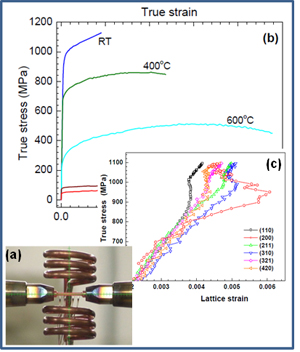
The SNS’s VULCAN diffractometer probes in situ deformation of a nanostructured ferritic alloy at elevated temperatures and under stresses (a), revealing the macroscopic (b) and microscopic (c) strain evolutions.
neutron diffraction characterization of strains in nanostructured materials reveals, for the first time, a large temperature-sensitive elastic anisotropy and a deformation crossover upon extensive straining. The novel approach utilized to determine single-crystal elastic constants provides a new strategy for characterizing anisotropic elasticity of complex materials.
Nanostructured ferritic alloys, whose microstructure features numerous oxide nanoclusters embedded in ferrite grains, have exceptional properties for service in high temperatures and high irradiation in future nuclear reactors. Understanding of their performance under stresses and at elevated temperatures has been conventionally gained from analyzing the reinforcing effect of nanoclusters. The present findings, however, offer new insights into the deformation mechanisms from the perspective of ferrite grains; these grains, as opposed to conventional isotropic approximations, behave substantially differently with respect to their orientations. A novel methodology for determining single-crystal elastic constants from textured alloys has been established by solving the inverse problem of polycrystalline elasticity. Mesoscale characterization of orientation-dependent strains, enabled by neutron diffraction at the Spallation Neutron Source, provides unique insights into thermo-mechanical behaviors of structural materials in extreme environments of high stresses and high temperatures.
G. M. Stoica, A. D. Stoica, M. K. Miller, and D. Ma, “Temperature-dependent elastic anisotropy and mesoscale deformation in a nanostructured ferritic alloy,” Nature Commun.5, 5178 (2014). doi:10.1038/ncomms6178