Key Points:
- An ORNL collaboration received the 2026 CAMX Combined Strength Award for a new approach to manufacturing composite forms to shape concrete for advanced nuclear construction.
- The project brought together national laboratory, university and industry capabilities to establish a new additive manufacturing supply chain for nuclear infrastructure.
- Reusable forms can be designed, 3D printed and delivered in about two weeks, compared with six months to build conventional steel molds.
The Department of Energy’s (DOE) Oak Ridge National Laboratory (ORNL) and collaborators earned the 2026 CAMX Combined Strength Award for developing advanced 3D-printed composite forms that can accelerate nuclear construction.
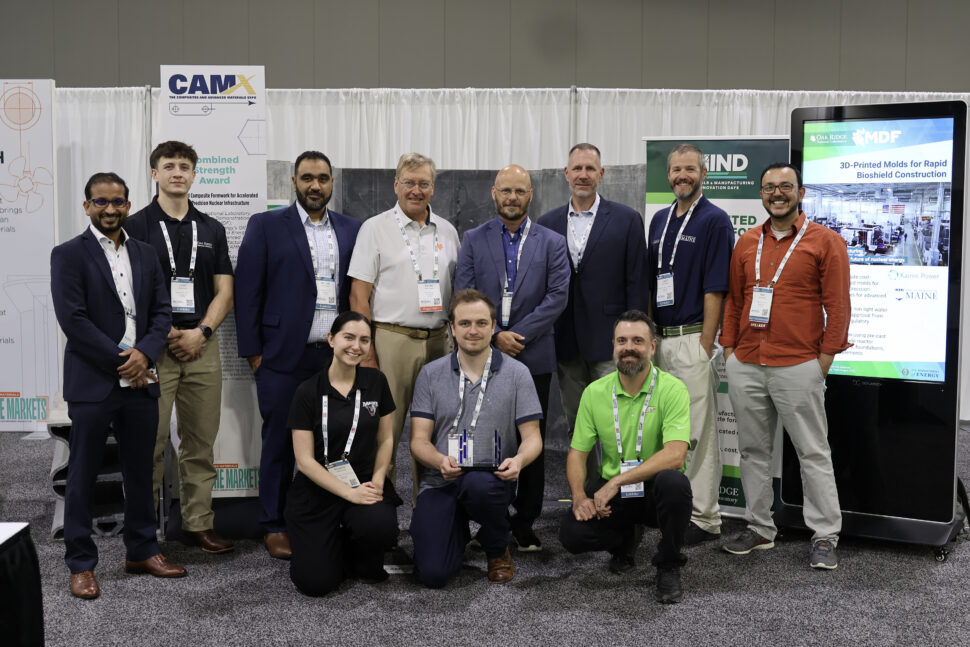
The award recognized the project “Advanced Composite Formwork for Accelerated High-Precision Nuclear Infrastructure.” The award is one of two flagship CAMX honors and recognizes team-based approaches that bring together complementary expertise to solve composites challenges.
The project brought together the Manufacturing Demonstration Facility at ORNL; DOE’s Office of Critical Minerals and Energy Innovation, Advanced Materials and Manufacturing Technologies Office (AMMTO); Kairos Power; the University of Maine’s Advanced Structures and Composites Center; Barnard Construction; Airtech Advanced Materials Group; JuggerBot 3D; Additive Engineering Solutions; Haddy; and Tru-Design.
“Accelerating advanced nuclear deployment requires rethinking how we build, not just how we design reactors,” said Ahmed Arabi Hassen, group leader of Composites Innovation at ORNL. “Conventional formwork is costly, labor-intensive and too slow to support the pace and scale of future nuclear construction. Through large-scale additive manufacturing and strong industry partnerships, we are transforming this bottleneck into an opportunity to build faster, smarter and more affordably.”
The team developed a digital manufacturing process for producing fiber-reinforced composite forms that provides a faster alternative for complex nuclear construction. The reusable forms can be designed, 3D printed and delivered in about two weeks, compared with six months to build conventional steel molds.
“This award demonstrates what’s possible when national laboratories, universities and industry combine their expertise to move advanced manufacturing technologies into real-world use,” said Robert Wagner, associate laboratory director for ORNL’s Energy Science and Technology Directorate. “Partnerships like this help strengthen U.S. manufacturing capabilities while creating practical solutions for advanced nuclear energy.”
Large-scale additive manufacturing and precision machining enabled the team to produce forms for concrete geometries that are difficult to produce with conventional formwork, including interlocking joints that support grout-free assembly of radiation-shielding panels. The forms achieved one-sixteenth-inch precision on critical surfaces while withstanding the substantial pressure exerted by the concrete they were built to shape.
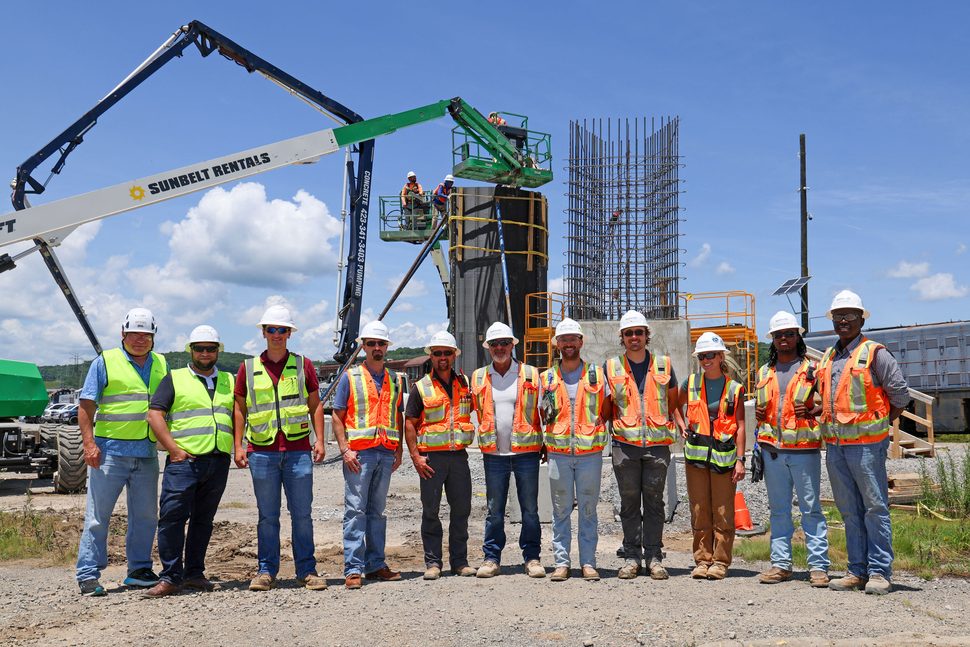
The technology has progressed from development to full-scale demonstrations at Kairos Power’s Oak Ridge campus, where the Hermes Low-Power Demonstration Reactor is under construction. Each section used in the shielding demonstration measures 10 feet by 10 feet, with three sections stacked to create a column. The forms are precursors to those Kairos Power and Barnard Construction plan to use for portions of the Hermes reactor facility.
The demonstration also created a direct feedback loop between manufacturing and construction. Barnard Construction implemented and adapted the 3D printed forms, providing real-time feedback that informed design changes to improve constructability and deployment. That connection among materials, additive manufacturing, machining, construction and nuclear expertise reflects the team-based approach recognized by the CAMX Combined Strength Award.
The Manufacturing Demonstration Facility, where the ORNL portion of the work was performed, is supported by DOE’s AMMTO and acts as a nationwide consortium of collaborators focused on innovating, inspiring and catalyzing the transformation of U.S. manufacturing.
UT-Battelle manages ORNL for the DOE’s Office of Science, the single largest supporter of basic research in the physical sciences in the United States. The Office of Science is working to address some of the most pressing challenges of our time. For more information, please visit energy.gov/science.