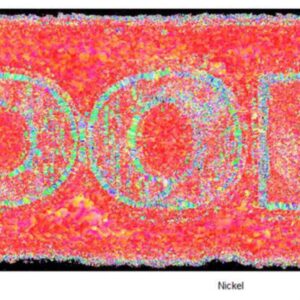
Sometimes the best explanations of “Big Science” come from the people just discovering it. A graduate student in a manufacturing course organized through the United States Council for Automotive Research (USCAR) recently captured that moment after a guest lecture from Oak Ridge National Laboratory materials scientist Alex Plotkowski on metal additive manufacturing.
In 1961, ORNL’s storied former director Alvin Weinberg coined the term “big science” in a journal article published in Science. This story explores his meaning of “big science,” and how the concept relates to the future of interconnected science labs.
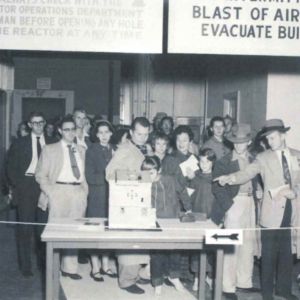
Some less-often-told tales from ORNL's colorful past. "This wonderful old reactor." Veterans celebrated the Graphite Reactor's 50th anniversary in 1993. Presidential visit, 1992: George H.W. Bush visited ORNL to sign a CRADA. When Tiger Teams prowled: Tom Row spearheaded the controvers...
The 'greatest Oak Ridger' makes some crisp observations about the nuclear contract, science and government, genteel poverty, getting fired, his friend and mentor Eugene Wigner and the Friendship Bell.
By the time chatbots and other trendy AI tech began dominating business and pop culture, ORNL had already spent four and a half decades advancing AI as a cutting-edge research tool. In other words, if you were born the day the Oak Ridge Applied Artificial Intelligence Project was created in 1979, AARP flyers might soon
AI for materials Everything depends on materials. From improving new batteries for electric vehicles to studying the atomic structure of metallic glass, ORNL researchers are laser-focused on finding the revolutionary materials that will make the world a better, more sustainable place in the 21st century. How does one discover a new material, you ask? Today,
Like materials science, drug development can be an endless guessing game. We know a lot about chemicals and their properties; what we need to know is how they will interact to address specific health problems. It’s a much more difficult problem, like looking for a needle in an ocean of haystacks. “One of the challenges
If electricity is the life blood of the country, then the power grid is its arteries. Don’t believe it? Just turn off the power for a couple of days. The effects would go way beyond spoiled leftovers, from nonfunctioning medical centers to blinking traffic lights. And with the rise of electric vehicles, the power grid
While most technology has advanced faster than anyone could have anticipated, one area is still particularly challenging: weather forecasting. And with good reason. The technology for this science has improved significantly over the years, but weather forecasting remains very hard due to seemingly endless variables. Check out any local forecast and you’ll see just 10
The development of powerful and seemingly human-like artificial intelligence can be a great boon to society. On the other hand, AI has also created new ways for doing great harm. These risks are not only about misuses of AI but also about threats to AI systems. In the wrong hands, these systems can be used
ORNL has hosted four of the world’s top supercomputers since 2009, establishing the laboratory as a center for cutting-edge computational science and high-performance computing. The laboratory’s journey to leadership in scientific computing began in the early 1990s from a nearly blank slate. At the close of the 1980s, computing resources at the laboratory were modest,
ORNL is proud of its role in fostering the next generation of scientists and engineers. We bring in talented young researchers, team them with accomplished staff members, and put them to work at the lab’s one-of-a-kind facilities. The result is research that makes us proud and prepares them for distinguished careers. We asked some of