A novel method enables the enrichment and analysis of paramagnetic actinide particles suspended in complex environmental matrices. The approach enhances the ability to detect and characterize actinide materials used in nuclear processes while preserving particle integrity. By offering improved particle separation and single-particle analysis, the technology supports safeguards, nuclear forensics, and compliance monitoring by regulatory
Counterfeit refrigerants pose increasing risks to HVACR systems, leading to equipment failure, safety concerns, and environmental violations. This portable detection technology provides a cost-effective solution to quickly and accurately identify unauthorized refrigerant blends, improving safety and compliance in both industrial and commercial applications. Description The technology consists of a compact detection device featuring a sealed
We presented a novel apparatus and method for laser beam position detection and pointing stabilization using analog position-sensitive diodes (PSDs). The system demonstrated an order of magnitude improvement in both radiation tolerance and bandwidth compared to traditional image sensor-based methods. It is particularly well-suited for applications requiring high-bandwidth tracking and stabilization of laser beam positions
A novel method that prevents detachment of an optical fiber from a metal/alloy tube and allows strain measurement up to higher temperatures, about 800 C has been developed. Standard commercial adhesives typically only survive up to about 400 C. But, they detach at >500 C at the higher operating temperatures. This problem has been solved
Quantifying tool wear is historically challenging task due to variable human interpretation. This capture system will allow for an entire side and the complete end of the cutting tool to be analyzed. All of these measurements can also be taken in the machine either before or after the cut has been taken. This does not
A new large-area thermal neutron detector has been developed to improve the detection and imaging of neutrons. This detector uses a special type of material (6LiF/ZnS(Ag) scintillator) that turns neutrons into light. Wavelength-shifting fibers then convert this light into a form that can be detected and processed. The detector’s design includes a unique positioning system
Neutron scattering experiments cover a large temperature range in which experimenters want to test their samples. Commonly used equipment can cool and heat samples in ranges from about 10K up to 750K, but the thermometry cannot provide accurate readings below 28K; thermometers that read lower than this temperature will not survive the high temperature environment.
High coercive fields prevalent in wurtzite ferroelectrics present a significant challenge, as they hinder efficient polarization switching, which is essential for microelectronic applications. While methods exist to facilitate polarization switching in nitrides, direct write methods for engineering ferroelectricity are limited. This technology consists of strategic ion irradiation techniques to stabilize defects conducive to enhanced device
The quality and quantity of refrigerant charge in any vapor compression-based heating and cooling system is vital to its energy efficiency, thermal capacity, and reliability. But it also imposes significant risk as improper charging of the vapor compression system at the factory or in the field results in significant performance issues, resulting in both energy
Faults in the power grid cause many problems that can result in catastrophic failures. Real-time fault detection in the power grid system is crucial to sustain the power systems’ reliability, stability, and quality. However, conventional fault detection systems are vulnerable and do not work on real-world data. This technology is an envelope-detector-based phase fault detection
Polarization drift in quantum networks is a major issue. Fiber transforms a transmitted signal’s polarization differently depending on its environment. This technology strengthens quantum networking by providing automatic polarization compensation using ultra-sensitive detection of coexisting dim reference signals. It achieves fast and complete control of the polarization of light while ensuring 100% uptime by using
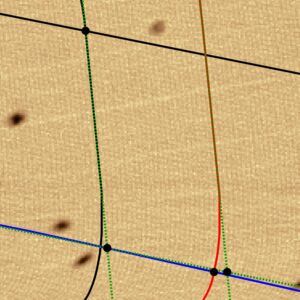
Distortion in scanning tunneling microscope (STM) images is an unavoidable problem. This technology is an algorithm to identify and correct distorted wavefronts in atomic resolution STM images. This algorithm can be used to correct nonlinear in-plane distortions without prior knowledge of the physical scanning parameters, the characteristics of the piezoelectric actuator, or individual atom positions.