
Completed in 1965 and operating at 85 megawatts, the High Flux Isotope Reactor’s steady-state neutron beam is the strongest reactor-based neutron source in the United States. The thermal and cold neutrons produced by HFIR are used to study physics, chemistry, materials science, engineering, and biology. The intense neutron flux, constant power density, and constant-length fuel cycles are used by more than 500 researchers each year for neutron scattering research into the fundamental properties of condensed matter.
The neutron scattering research facilities at HFIR contain a world-class collection of instruments used for fundamental and applied research on the structure and dynamics of matter. HFIR is also used for medical, industrial, and research isotope production; research on severe neutron damage to materials; and neutron activation analysis to examine trace elements in the environment. Additionally, the building houses a gamma irradiation facility that uses spent fuel assemblies and can provide high gamma doses for studies of the effects of radiation on materials.
Recent discoveries made possible by neutrons at HFIR are helping to unravel the secrets of materials and energy. This new knowledge also leads to improvements in everyday products, such as hard drives and medicine. In addition, HFIR’s capabilities help solve crimes and isotopes produced at HFIR are fueling the discovery of new elements and space flight.
View an interactive story about HFIR here: High Flux Isotope Reactor: Forged in safety, fueled by discovery.
Learn more about HFIR’s importance to the nation and world in this video: HFIR: A Discovery Powerhouse.
A Little History on a Very Big Deal
January 17, 1958: The U.S. Atomic Energy Commission endorsed ORNL’s High Flux Isotope Reactor
The status of the transuranium production program was critically reviewed by the U.S. Atomic Energy Commission (AEC) Division of Research at a meeting on January 17, 1958.
At that time, the AEC decided to embark on a program designed to meet the anticipated needs for transuranium isotopes by undertaking certain irradiations in existing reactors. By late 1958, it became apparent that acceleration of this program was desirable.
Following a meeting in Washington, D.C., on November 24, 1958, the AEC recommended that a high-flux reactor be designed, built, and operated at ORNL, with construction to start in FY 1961.

(Photo Credit: ORNL/U.S. Dept. of Energy)

August 25, 1965: High Flux Isotope Reactor achieved criticality
ORNL’s unique High Flux Isotope Reactor (HFIR), designed to produce research quantities of the transuranium elements, achieved criticality at 2:22 p.m. on Wednesday, August 25, 1965.
Eleven transuranium elements had been created since 1940, using cyclotrons, reactors, or nuclear explosions. HFIR was the first reactor in the United States designed specifically to produce new elements—principally americium, curium, berkelium, and californium.
A.L. Boch, director of the reactor project, said HFIR would undergo a series of critical experiments and then gradually increase its power output.
Source: The ORNL News
August 27, 1965: A salute!
Mere days after HFIR first achieved criticality, ORNL Director Alvin M. Weinberg received a letter from Glenn T. Seaborg, Chairman of the U.S. Atomic Energy Commission. It contained the following:
Dear Al,
Congratulations on achieving initial criticality in the HFIR. You and your colleagues can be proud of the successful engineering in bringing the HFIR into operation. We all look forward to the promising work anticipated from this facility.
Source: The ORNL News

(Photo Credit: ORNL/U.S. Dept. of Energy)
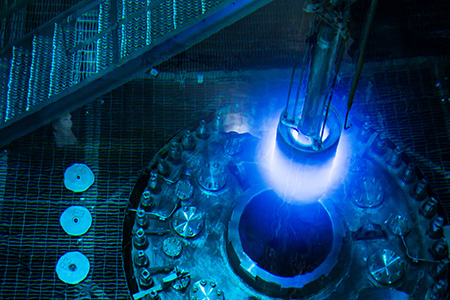
(Photo Credit: ORNL/U.S. Department of Energy)
February 4, 1966: Two major, advanced design reactors tested at higher power levels
The United States’ reactor program took an important step forward when two new nuclear reactors at Oak Ridge National Laboratory began to operate at significant power levels almost simultaneously.
The Molten Salt Reactor Experiment (MSRE) and the High Flux Isotope Reactor (HFIR) had been under construction for five years and had achieved initial criticality in mid-1965.
HFIR would produce, for the first time, sizeable quantities of the synthetic elements including berkelium, californium, einsteinium, and fermium. Some of these had existed only in the stars in weighable amounts.
Source: The ORNL News
September 9, 1966: HFIR at full power
ORNL’s longest-standing lab director Alvin M. Weinberg announced that HFIR had reached full power in his opening speech at the ceremony marking the Graphite Reactor becoming a Registered National Landmark.
“I am pleased to announce that the modern successor to the Graphite Reactor, the High Flux Isotope Reactor, which is to produce the first gram quantities of californium, has achieved full power. [On] Friday, September 9, at 7:46 p.m., HFIR for the first time reached its full design power. … That a new, much higher-powered reactor comes into being, phoenix-like, even as we dedicate an older reactor to history, augurs well for the future.”
Source: The ORNL News

(Photo Credit: ORNL/U.S. Dept. of Energy)
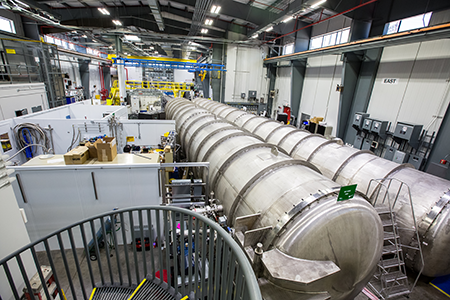
(Photo Credit: Genevieve Martin/ORNL/U.S. Dept. of Energy)
May 2007: HFIR unveiled upgrades including new instruments and cold neutron source
In 2007, HFIR completed the most dramatic transformation in its 40-year history.
During a shutdown of more than a year, the facility was refurbished and a number of new instruments were installed, as well as a cold neutron source. The reactor was restarted in mid-May; it attained its full power of 85 MW within a couple of days, and experiments resumed within a week.
Improvements and upgrades to HFIR included an overhaul of the reactor structure for reliable, sustained operation; significant upgrading of the eight thermal-neutron spectrometers in the beam room; new computer system controls; installation of the liquid hydrogen cold source; and a new cold neutron guide hall.
November 2014: HFIR named Nuclear Historic Landmark
The High Flux Isotope Reactor (HFIR), which provides neutrons for research and isotope production at the Department of Energy’s Oak Ridge National Laboratory, was designated a Nuclear Historic Landmark by the American Nuclear Society (ANS).

(Photo Credit: Jason Richards/ORNL/U.S. Department of Energy)

Bk-249 was the precursor isotope for the element 117 campaign, led at ORNL by Jim Roberto.
(Photo Credit: Frank Riley/Radiochemical Engineering Development Center)
June 8, 2015: Element 117 named tennessine
The discovery of element 117, a synthetic element that does not occur in nature, required many years of collaborative research by dozens of scientists from several international institutions.
The experiment that produced the first evidence of element 117 could not have happened without multiple world-class scientific facilities, including those at the Department of Energy’s Oak Ridge National Laboratory.
On June 8, 2015, the International Union of Pure and Applied Chemistry (IUPAC) Inorganic Chemistry Division published a Provisional Recommendation for the name tennessine and symbol Ts for element 117. In doing so, IUPAC recognized the contributions of Oak Ridge National Laboratory, Vanderbilt University, and the University of Tennessee at Knoxville to superheavy element research, including the production and chemical separation of unique actinide target materials for superheavy element synthesis at ORNL’s HFIR-REDC facilities.
December 8, 2022: HFIR completed its 500th fuel cycle
On December 8, 2022, the High Flux Isotope Reactor was restarted for its 500th fuel cycle since operations began in 1965.
Nearly 200 ORNL staff turned out on a beautiful day Tuesday, December 13, for a special event celebrating the 500th fuel cycle of the High Flux Isotope Reactor. A giant celebratory banner hung on the building, providing lovely color against the backdrop of a sunny, blue sky, on one of the first nice days following a long stretch of rainy weather.
Lab leadership said the 500th fuel cycle achievement was significant and thanked staff for their service and dedication that resulted in many scientific accomplishments over the decades.

(Photo Credit: Carlos Jones/ORNL/U.S. Dept. of Energy)

(Photo Credit: ORNL/U.S. Dept. of Energy)
October 9, 2024: HFIR a fit for Nobel laureate’s designer proteins
Biochemist David Baker was announced as the recipient of the Nobel Prize for Chemistry on October 9, 2024, for his work on proteins performed, in part, at HFIR.
In 2018, Baker designed a protein he thought could bind to amantadine, a drug used in the treatment of Parkinson’s disease. Baker’s new computationally designed amantadine-binding protein (ABP) is a potential control switch in targeted anti-cancer cell therapies. However, to confirm the complete structure and function of the assembled protein, a critical piece of information was missing. HFIR’s IMAGINE instrument delivered the missing piece (the location of hydrogen bonds in the ABP complex) through neutron scattering. This technique allowed Baker and his team to see hydrogen, a capability no other research technique can provide.