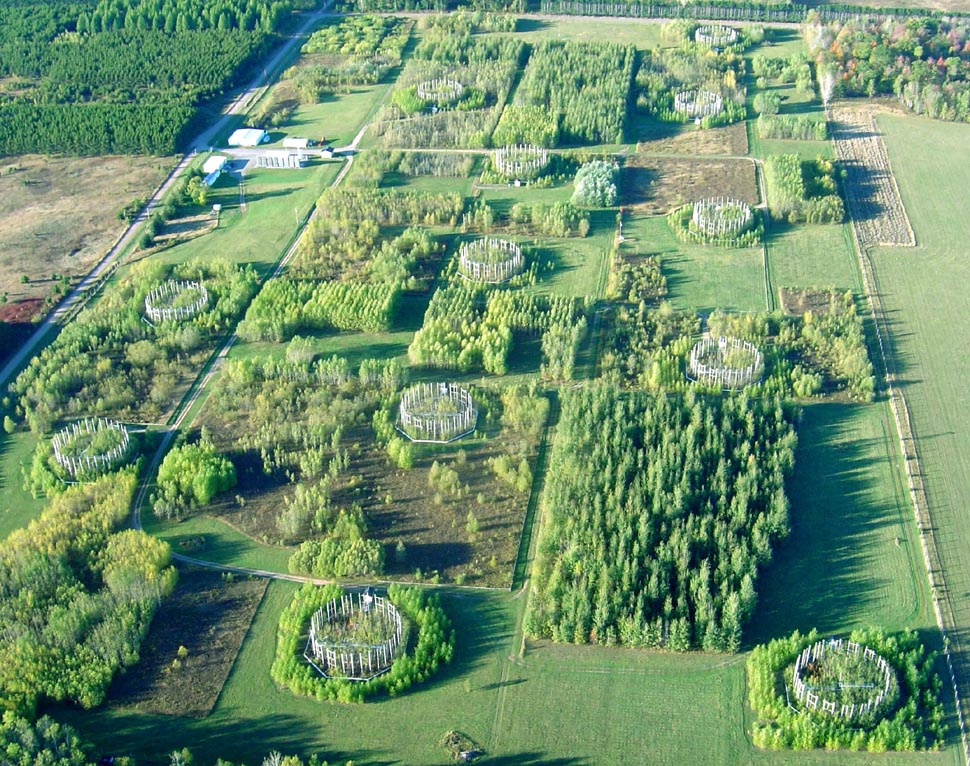
Located at the Harshaw Experimental Forest near Rhinelander, Wisconsin, the Aspen FACE Experiment operated as a DOE User Facility, and was a collaborative effort among 11 organizations.
Since the mid-1990s, the U.S. Department of Energy (DOE) supported large-scale experiments to study how ecosystems respond to changing atmospheric conditions. Through the Terrestrial Carbon Processes Program and the Program for Ecosystem Research, DOE funded two major types of trace gas enrichment experiments:
Initially, FACE sites were developed as research and development platforms, later evolving into environmental research user facilities open to the broader scientific community. DOE’s Biological and Environmental Research (BER) program operated four FACE facilities distributed across the United States. Brookhaven National Laboratory provided central operations and coordination for several FACE sites. BER also supported OTC experiments in partnership with the Smithsonian Environmental Research Center in Maryland and Florida.
Together, these projects contributed to a global network of FACE experiments, connecting U.S. research efforts with international studies to better understand carbon, nutrient, and water cycles across ecosystems.
Research
By studying how an entire forest stand functions as a system rather than isolated parts, the ORNL FACE experiment sought to understand how the eastern deciduous forest will be affected by CO2enrichment of the atmosphere. The project also sought to quantify the carbon feedback from the forest to the atmosphere.
Features
Facility: Five 25-meter experiment plots built within a deciduous forest plantation on the Oak Ridge Environmental research park.
Forest Type: The stand was a sweetgum (Liquidambar styraciflua) monoculture planted in 1988, about 18 meters tall with a fully closed canopy.
Key Characteristics:
A closed canopy limited individual tree growth, creating realistic competition for light.
Full root occupancy constrained nutrient cycling, offering insights into long-term soil changes.
The larger size of mature trees compared to seedlings altered carbon cycling dynamics.
The extended time frame allowed scientists to measure gradual changes in soil carbon and ecosystem processes.
Data
The FACE data provided on this site are freely available and were furnished by individual FACE scientists who encourage their use. Please inform Rich Norby (Principal Investigator, ORNL FACE, [email protected]) of how you are using these data and of any publication plans.
Norby R J ; Iversen C M ; Warren J M ; Childs J ; Tharp M L (2010): Carbon and Nitrogen Stocks and Fluxes at ORNL FACE, Oak Ridge, Tennessee, 1998-2008. ORNL FACE Experiment, ESS-DIVE repository. Dataset. https://doi.org/10.15485/3020390
Annual carbon and nitrogen stocks and fluxes in wood, leaf, coarse root, and fine root fractions (1998-2008)
Biomass
Net Primary Production
Productivity
Carbon Mass
Nitrogen Mass
C:N Ratio
Nitrogen Uptake and Use Efficiency
Leaf Traits
PAR
Litter Mass
Riggs J ; Tharp M ; Norby R (2007): ORNL FACE Weather Data. CDIAC, ESS-DIVE repository. Dataset. https://doi.org/10.15485/1463817
Weather Data (1999-2010, gap-filled 1999-2008)
Air Temperature
PAR
Precipitation
Relative Humidity
Soil Temperature
Solar Irradiance
Wind Speed
Riggs J ; Tharp M ; Norby R (2007): ORNL FACE CO2 Concentration Data. CDIAC, ESS-DIVE repository. Dataset. https://doi.org/10.15485/1463842
Carbon Dioxide Concentration Data (1999-2010, gap-filled 1999-2008)
Carbon Dioxide
Solar Angle
Wind Direction
Wind Speed
Norby R ; Tharp M (2007): ORNL FACE Leaf Area Index (LAI). CDIAC, ESS-DIVE repository. Dataset. https://doi.org/10.15485/1463810
Ledford J ; Norby R ; Tharp M (2007): ORNL FACE Fine Root Data. CDIAC, ESS-DIVE repository. Dataset. https://doi.org/10.15485/1463811
Fine Root Data (1998-2007)
Root Mortality
Root Production
Root Standing Crop
Norby R ; Iverson C ; Tharp M (2007): ORNL FACE Nitrogen Concentrations (Leaves, Litter, Fine Roots, Wood). CDIAC, ESS-DIVE repository. Dataset. https://doi.org/10.15485/1463845
Tree Nitrogen Concentrations (1998-2009)
Leaf Nitrogen
Litter Nitrogen
Fine Root Nitrogen
Wood Nitrogen
Finzi A C ; Norby R J ; Calfapietra C ; Gallet-Budynek A ; Gielen B ; Holmes W E ; Hoosbeek M R ; Iversen C M ; Jackson R B ; Kubiske M E ; Ledford J ; Liberloo M ; Oren R ; Polle A ; Pritchard S ; Zak D R ; Schlesinger W H ; Ceulemans R (2007): Nitrogen Stocks and Fluxes Across Four FACE Experiments, 1996-2004. ORNL FACE Experiment, ESS-DIVE repository. Dataset. https://doi.org/10.15485/3018019
Nitrogen stocks and fluxes across wood, canopy, and fine root, leaf litter, and fine root mortality pools at ORNL FACE, Duke Forest FACE, Aspen FACE, and POP-EURO FACE sites (1996-2004)
Biomass
Net Primary Production
Productivity
Nitrogen Concentration
Nitrogen Mass
Nitrogen Uptake and Use Efficiency
Nitrogen Requirement, Retranslocation, and Return
Norby R (2021): ORNL FACE Tree Height, with data on height of a subset of trees measured every year, 1997-2009. Free-Air CO2 Enrichment (FACE) Experiment Synthesis Activities. ORNL FACE Experiment, ESS-DIVE repository. Dataset. https://doi.org/10.15485/1798175
Tree Height (1997-2009)
Norby R ; Warren J ; Iversen C ; Childs J (2021): ORNL FACE Final Harvest, 2009, with data on leaf characteristics and tree mass. ORNL FACE Experiment, ESS-DIVE repository. Dataset. https://doi.org/10.15485/1779883
The FACTS-I experiment helped researchers understand how forests store carbon, cycle nutrients, and interact with the atmosphere. Insights from this work are improving ecosystem and carbon cycle models, supporting more accurate predictions of how forests may function under future environmental conditions.
Features
FACTS-I included eight FACE plots—four exposed to higher CO₂ concentrations and four that remain at natural levels as controls. The system began operation in 1994 with a prototype plot pair, followed by three additional plot pairs in 1996. The plots were sited in an unmanaged loblolly pine (Pinus taeda) plantation that had been established in 1983.
In 1998, the prototype and its reference plot were divided by a soil barrier to enable combined CO₂ and soil nutrient enrichment experiments. This design was later expanded in 2005 to include all plot pairs, strengthening the dataset and enhancing the ability to study the effects of nitrogen in long-term forest responses to elevate CO2.
Comprehensive CO₂ Control: FACE technology allowed researchers to raise or maintain atmospheric CO₂ levels in open-air forest environments.
Integrated Soil Experiments: Soil barriers and nutrient additions made it possible to analyze how belowground processes interact with atmospheric changes.
Long-Term Data Collection: With operations spanning more than two decades, the facility provided rare, continuous measurements of forest carbon dynamics.
Scalable Design: The combination of elevated and ambient CO₂ plots allowed for comparisons across time, species, and treatment types.
Data
DUKE FACE data contained in the datasets below are freely available and were furnished by individual FACE scientists who encourage their use. Data can be accessed at the Environmental System Science Data Infrastructure for a Virtual Ecosystem (ESS-DIVE) by clicking the links below. Please inform Ram Oren (Principal Investigator, Duke Forest FACE) of how you are using these data and of any publication plans.
User note: Meteorological data files have 30-minute averaged or summed (as appropriate for the variable) data. Date and time stamps are recorded at the beginning of each line where: JDT is Julian day + decimal time. JD1 = Jan 1, 1990.
Oren R ; Kim D ; Oishi A C ; Ward E (2022): Duke Forest FACE (FACTS-I): Meteorological and Soil Data. Duke Forest FACE – Forest-Atmosphere Carbon Transfer and Storage (FACTS-I), ESS-DIVE repository. Dataset. https://doi.org/10.15485/1895465.
Oren R ; Kim D. (2007): Duke Forest FACE (FACTS-I): Early Meteorological Data, 1993-1996. Duke Forest FACE – Forest-Atmosphere Carbon Transfer and Storage (FACTS-I), ESS-DIVE repository. Dataset. https://doi.org/10.15485/3365732
Meteorological Data (1993-1996)
Air Temperature
Precipitation
Relative Humidity
Saturated Vapor Pressure
Vapor Pressure Deficit
Hendry G ; Lewin K ; Oren R ; Kim D (2008): Duke Forest FACE (FACTS-I): Carbon Dioxide (CO2) Concentration, 1993-2007. Duke Forest FACE – Forest-Atmosphere Carbon Transfer and Storage (FACTS-I), ESS-DIVE repository. Dataset. https://doi.org/10.15485/3365734
Carbon Dioxide (CO2) Concentration (1993-2007)
Oren R ; Kim D (2008): Duke Forest FACE (FACTS-I): Radiation and Wind Measurements, 1993-2007. Duke Forest FACE – Forest-Atmosphere Carbon Transfer and Storage (FACTS-I), ESS-DIVE repository. Dataset. https://doi.org/10.15485/3365737
Cloud Cover
Photosynthetically Active Radiation (PAR)
Shortwave and Longwave Radiation
Solar Zenith Angle
Wind Speed and Direction
Finzi A C ; Norby R J ; Calfapietra C ; Gallet-Budynek A ; Gielen B ; Holmes W E ; Hoosbeek M R ; Iversen C M ; Jackson R B ; Kubiske M E ; Ledford J ; Liberloo M ; Oren R ; Polle A ; Pritchard S ; Zak D R ; Schlesinger W H ; Ceulemans R (2007): Nitrogen Stocks and Fluxes Across Four FACE Experiments, 1996-2004. ORNL FACE Experiment, ESS-DIVE repository. Dataset. https://doi.org/10.15485/3018019
Nitrogen stocks and fluxes across wood, canopy, and fine root, leaf litter, and fine root mortality pools at ORNL FACE, Duke Forest FACE, Aspen FACE, and POP-EURO FACE sites (1996-2004)
Biomass
Net Primary Production
Productivity
Nitrogen Concentration
Nitrogen Mass
Nitrogen Uptake and Use Efficiency
Nitrogen Requirement, Retranslocation, and Return
Oren R ; Kim D ; Maier C ; Oishi A ; Ward E ; Kim H ; McCarthy H ; Medvigy D ; Palmroth S ; Pataki D ; Phillips N ; Schäfer K ; Tor-ngern P (2023): Duke Forest FACE (FACTS-I): Plant and Soil Response Data. Duke Forest FACE – Forest-Atmosphere Carbon Transfer and Storage (FACTS-I), ESS-DIVE repository. Dataset. https://doi.org/10.15485/2283434
Soil Temperature (1997-2004, Gap Filled: 2004-2006)
Research
Desert ecosystems may experience changes in productivity and water use under shifting CO₂ conditions. To better understand these dynamics, NDFF examined how carbon, nutrients, and water interact in an arid environment over time and seeks to answer several critical questions about the future of desert ecosystems:
Will there be changes in the rate at which plants grow over the next hundred years?
Will the storage of carbon in the desert ecosystem change?
Will water balance change in this arid environment?
Will species composition of desert plant communities change?
Features
The NDFF used Free-Air CO₂ Enrichment (FACE) technology to increase carbon dioxide levels in open-air environments without disrupting natural conditions.
At the NDFF site in the Mojave Desert, CO₂ concentrations are elevated by 50% above current atmospheric levels in three large experimental plots. Six additional plots remained at natural CO₂ levels to serve as controls.
This design allowed scientists to directly compare plant and ecosystem responses to different CO₂ levels and measure how carbon, nutrients, and water cycles are regulated in desert systems.
Data
The FACE data provided on this site are freely available and were furnished by individual FACE scientists who encourage their use. Data can be accessed at the Environmental System Science Data Infrastructure for a Virtual Ecosystem (ESS-DIVE) by clicking the links below.
Charlet D (2007): Nevada Desert Face Facility Micrometeorological Data. CDIAC, ESS-DIVE repository. Dataset. https://doi.org/10.15485/1463843
Micrometeorological Data
Precipitation (1996-2006)
Wind speed (1997-2006)
Relative humidity (2001-2006)
Air temperature (1997- 2006)
PAR (2000-2006)
Solar radiation (1998- 2006)
CO2 concentration (1997-2006)
Operations
CO2 usage (1997-2005)
Plant Responses
Larrea tridentata shoot growth (1998-2002)
Soil characteristics
Soil particle size (1997)
Soil texture (1997)
Soil water potential (1997-2005)
Operations
CO2 usage (1997-2005)
Smith S ; Housman D (2007): Nevada Desert Face Facility Larrea tridentata Shoot Growth. CDIAC, ESS-DIVE repository. https://doi.org/10.15485/1463819
Plant responses
Larrea tridentata shoot growth (1998-2007)
Micrometeorological Data
Precipitation (1996-2006)
Wind speed (1997-2006)
Relative humidity (2001-2006)
Air temperature (1997- 2006)
PAR (2000-2006)
Solar radiation (1998- 2006)
CO2 concentration (1997-2006)
Operations
CO2 usage (1997-2005)
Soil characteristics
Soil water potential (1997-2005)
Nowak R (2007): Nevada Desert Face Facility Soil Water Content (%Vol). CDIAC, ESS-DIVE repository. Dataset. https://doi.org/10.15485/1463807
Soil Particle Fractions (1997)
Soil Texture (1997)
Soil Water Content (1997-2005)
Zitzer S (2007): Nevada Desert Face Facility Soil Texture and Particle Size. CDIAC, ESS-DIVE repository. Dataset. https://doi.org/10.15485/1463804
Soil Particle Fractions (1997)
Soil Texture (1997)
Soil Water Content (1997-2005)
Research
By simulating various atmospheric conditions in a controlled, open-air environment, Aspen FACE helped scientists better understand how forests grow, store carbon, and interact with surrounding environments under elevated gas levels. Aspen FACE investigated critical questions about how forests process and store carbon, and how they respond to environmental stressors:
Where is the “missing carbon” from global carbon models?
Is it being sequestered by forests?
Will more or less CO2 be sequestered by forest trees as CO2 levels rise?
Are forests net carbon sources or sinks? Do they change over time?
Is carbon sequestered by trees stored for long time periods in the soil?
Will elevated CO2 alleviate other stresses (e.g. ozone, drought, low fertility)?
Will our forests become more or less productive over time under elevated CO2?
How will elevated CO2 affect insect and disease interactions with trees?
How do CO2 and the greenhouse gas ozone interact?
Features
The Aspen FACE site included twelve 30-meter rings, each capable of controlling the concentrations of CO₂ and ozone in the air. This design allowed researchers to study the effects of each gas independently—and in combination—on a wide range of ecosystem characteristics, including:
Tree growth and development
Leaf and root structure
Soil carbon storage
Nutrient cycling and ecosystem function
Each ring was equipped with vertical ventpipes that release CO₂, ozone, or ambient air into the center of the plot. A computer-controlled feedback system continuously adjusted gas release every second to maintain consistent elevated levels.
Because the system operated in open air with no physical barriers, the forest’s natural conditions remained intact, aside from the controlled changes in gas concentrations.
Data
ORNL FACE data are freely available and were furnished by individual FACE scientists who encourage their use. Data can be accessed at the Environmental System Science Data Infrastructure for a Virtual Ecosystem (ESS-DIVE) or the Michigan Technological University’s Aspen FACE website by clicking the links below.
North Central Research Station. 2007. Aspen FACE Meteorological and Soil Data. CDIAC, ESS-DIVE repository. https://doi.org/10.15485/1463820
Meteorological Data (1998-2006)
Air temperature
Barometric Pressure
Relative Humidity
Net Radiation
Photosynthetically Active Radiation (PAR)
Precipitation
Wind Speed and Direction
Soil Temperature (1998-2006)
Soil Moisture (1998-2006)
Finzi A C ; Norby R J ; Calfapietra C ; Gallet-Budynek A ; Gielen B ; Holmes W E ; Hoosbeek M R ; Iversen C M ; Jackson R B ; Kubiske M E ; Ledford J ; Liberloo M ; Oren R ; Polle A ; Pritchard S ; Zak D R ; Schlesinger W H ; Ceulemans R (2007): Nitrogen Stocks and Fluxes Across Four FACE Experiments, 1996-2004. ORNL FACE Experiment, ESS-DIVE repository. Dataset. https://doi.org/10.15485/3018019
Nitrogen stocks and fluxes across wood, canopy, and fine root, leaf litter, and fine root mortality pools at ORNL FACE, Duke Forest FACE, Aspen FACE, and POP-EURO FACE sites (1996-2004)
The Carbon Dioxide Information Analysis Center (CDIAC) served as the central data repository and archive for DOE-supported FACE and OTC research. The FACE Data Management System ensures that datasets are openly available and accessible to researchers worldwide, supporting cross-site data analysis and synthesis.
As part of this system, CDIAC:
Conducted quality assurance and control (QA/QC) on submitted data
Reviewed and standardized documentation
Researchers can visit individual site pages for more detailed information and direct data access.
All of these datasets are now archived and made available on the ESS-DIVE data repository.
DOE Research Network
These projects are part of the CO₂ research network supported by the Global Change and Terrestrial Ecosystems core project of the International Geosphere-Biosphere Programme. Results from the experiments contribute to the Terrestrial Ecosystem Response to Atmospheric and Climatic Change initiative, a five-year effort that integrates experimental data and global change modeling.
The Free Air CO₂ Enrichment Model-Data Synthesis (FACE-MDS) project was created in 2008 with support from the National Center for Ecological Analysis and Synthesis. Since 2011, the FACE-MDS has been funded by the U.S. Department of Energy’s Office of Science through the Biological and Environmental Research program.
The project’s initial goal was to benchmark model predictions of how ecosystems respond to elevated atmospheric CO2. Initially we used data from two of the most comprehensive long-term studies of forest and ecosystem responses to higher CO₂ levels: the Duke and Oak Ridge FACE experiments. As the project evolved, the focus shifted towards uncovering the underlying assumptions that shape model behavior, developing an approach called assumption-centered modeling. We also expanded the sites in the analysis to include the Rhinelander FACE site, the Kennedy Space Center OTC experiment in a scrub-oak ecosystem, and the Prairie Heating and CO2 Enrichment (PHACE) experiment in a short-grass steppe ecosystem.
Over the years, FACE-MDS has brought together scientists from over 35 institutions across the U.S. and internationally. The project is led by principal investigators at Oak Ridge National Laboratory in the United States, with key partners at the Hawkesbury Institute for the Environment in Australia, the Max Planck Institute for Biogeochemistry in Germany, and the University of Bristol in the UK.
This international effort continues to strengthen global understanding of how atmospheric CO₂ affects plants, ecosystems, and Earth systems. The FACE-MDS project and team has advanced understanding of how terrestrial ecosystems respond to elevated atmospheric CO2, identified areas where models can be improved, highlighted new questions for future research, and set a new standard for comparing ecosystem models with experiment observations across the scientific community.
For questions about the work, contact Anthony Walker.