Vision
Develop solutions to environmental material degradation in extreme conditions and enable cost-effective technologies to advance the energy, transportation, and industrial sector
Mission
Lead research in materials degradation and corrosion mitigation through laboratory simulation of extreme environments, advanced characterization techniques, fundamental understanding of corrosion mechanisms, physics-based and machine-learning lifetime modeling, field studies, and industrial collaborations
R&D Scope
The Corrosion Science and Technology (CST) group is evaluating corrosion degradation in a broad range of harsh environments relevant to energy, transportation and industrial applications. This includes high-temperature and/or high-pressure steam, supercritical CO2, hydrogen, sulfidizing and carburizing environments, liquid metals, molten salts, and biofuels. The CST group members have extensive experience with materials fabricated by conventional and advanced processes from aluminum alloys and steels to Ni-based superalloys, refractory metals, advanced ceramics, and multi-material or graded structures, as well as corrosion-resistant, thermal barrier and environmental barrier coatings. Specialty areas are creating model alloys to assist in alloy design, mechanistic studies, lifetime modeling, and mechanical testing in controlled and/or corrosive environments.
Core Competencies
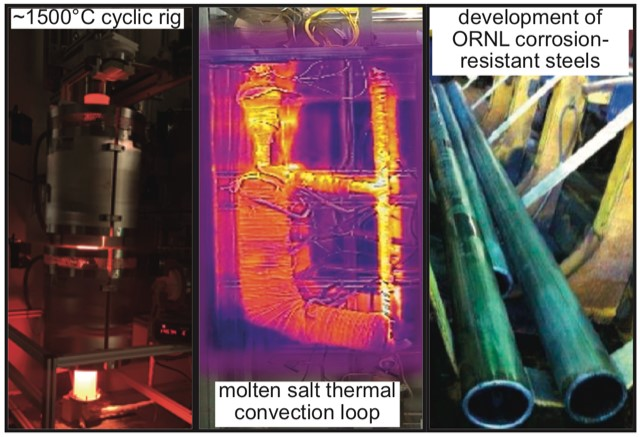
High-temperature cyclic rigs operating in controlled atmosphere at temperatures up to 1,450°C
High-temperature, high-pressure (1,300°C, 2MPa) systems for testing in complex harsh environments
Infrared hydrogen furnace allowing testing up to 1,500°C in high-purity hydrogen with rapid heating and cooling rates
Horizontal furnaces for exposure up to 1,100°C in low PO2 atmospheres including vacuum, Ar, He
Tensile, creep, fatigue, and burst testing in controlled environments such as steam, CO2, hydrogen, molten salt, liquid metals
Molten salt and liquid metal thermal convection loops
Aqueous/atmospheric corrosion testing by ASTM standards and AC/DC electrochemical methods for localized/uniform/galvanic corrosion investigation
Modeling environment-induced microstructure evolution and component lifetime prediction