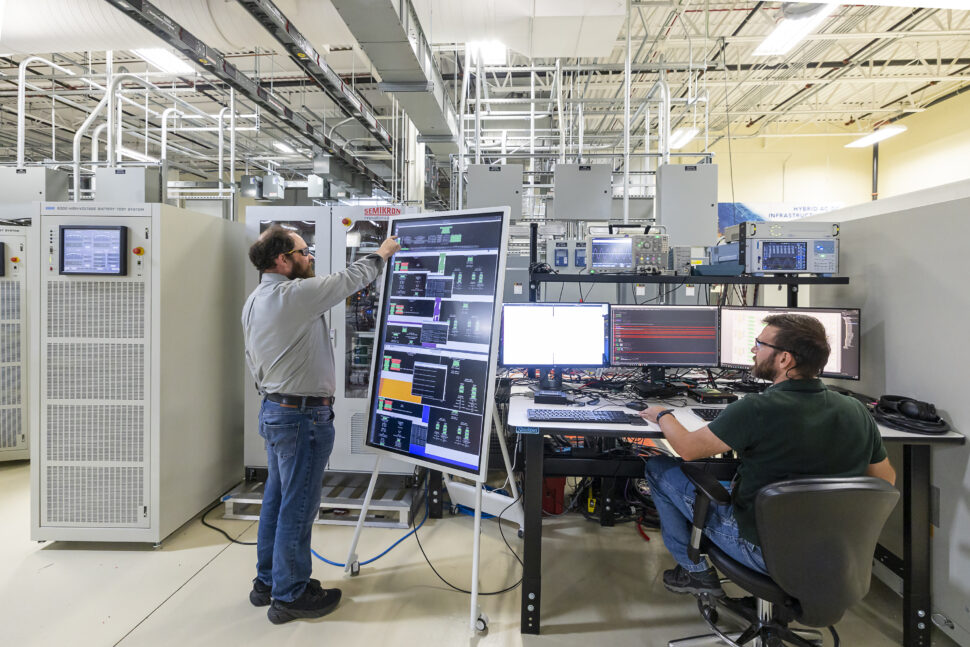
The Hybrid AC/DC lab provides a cutting-edge test bed for low-voltage power electronics, facilitating their integration with the electric grid. It allows for the emulation of diverse local energy assets, including energy storage and other on-site energy generation sources, to create a more resilient and flexible power system. The lab’s control room, coupled with advanced industry hardware and ORNL-developed agent-based communications, provides ultimate flexibility to the test bed.
This facility is the ideal environment for testing advanced, autonomous control strategies. Testing capabilities range from localized controls for power electronics to system-wide coordination of interconnected energy assets and sophisticated loads. Users can interface with power electronics at individual test stations or as an integrated system, and power supplies can be configured remotely to simulate the behavior of specific local energy sources and systems.

Uniqueness and capabilities
- Advanced Control: ORNL agent-based computers allow for the wide-scale integration of new converters into an autonomous, coordinated system.
- Flexible Emulation: The facility can emulate multiple combinations of local energy systems and power electronics for grid-edge applications, microgrid configurations, and hybrid AC/DC systems. This is critical for developing new power solutions and coordination strategies for high-demand, complex loads such as modern data centers and other critical infrastructure.
- High-Capacity Testing: Power electronics equipment and configurations can be tested using six linked test stations, each with 300kW of capability. Each station can simultaneously test up to two independent power-electronic-interfaced systems and emulated local resources, allowing for the analysis of up to 12 interconnected subsystems.
- Resilience and Robustness Validation: The lab can validate system and component performance against a wide range of simulated, real-world grid disturbances.
Technology resources
- Control and Optimization using Distributed Agent-based System (CODAS): A resource integration software test bed platform that integrates ORNL-developed hardware and software with advanced controls, communications, and protection.
- Hybrid AC/DC Bus Infrastructure: Features two 480V, 1200A 3-phase AC busways and one 1500V, 2400A DC busway, providing robust interconnection paths between the six test stations. Includes remote-controlled interfaces for each bus, allowing for reconfigurable trip settings, interconnect measurements, and isolation.
- Flexible Emulation: Each test station can simultaneously operate two source emulators (independently or coupled) and two load emulators (independently or coupled). This is ideal for modeling complex scenarios, such as integrating on-site power solutions with high-demand, variable loads like data centers.
- Grid Disturbance Simulation: Advanced grid emulators can simulate sags, swells, transients, and many other features to stress-test converters and the overall interconnected system for robustness and resilience.
- High-Power DC Test Systems: Includes remotely controllable bidirectional DC test systems, each capable of 100kW and operating at ranges of 600V and 1200V.
