Nanoscale Thermal Microscopy
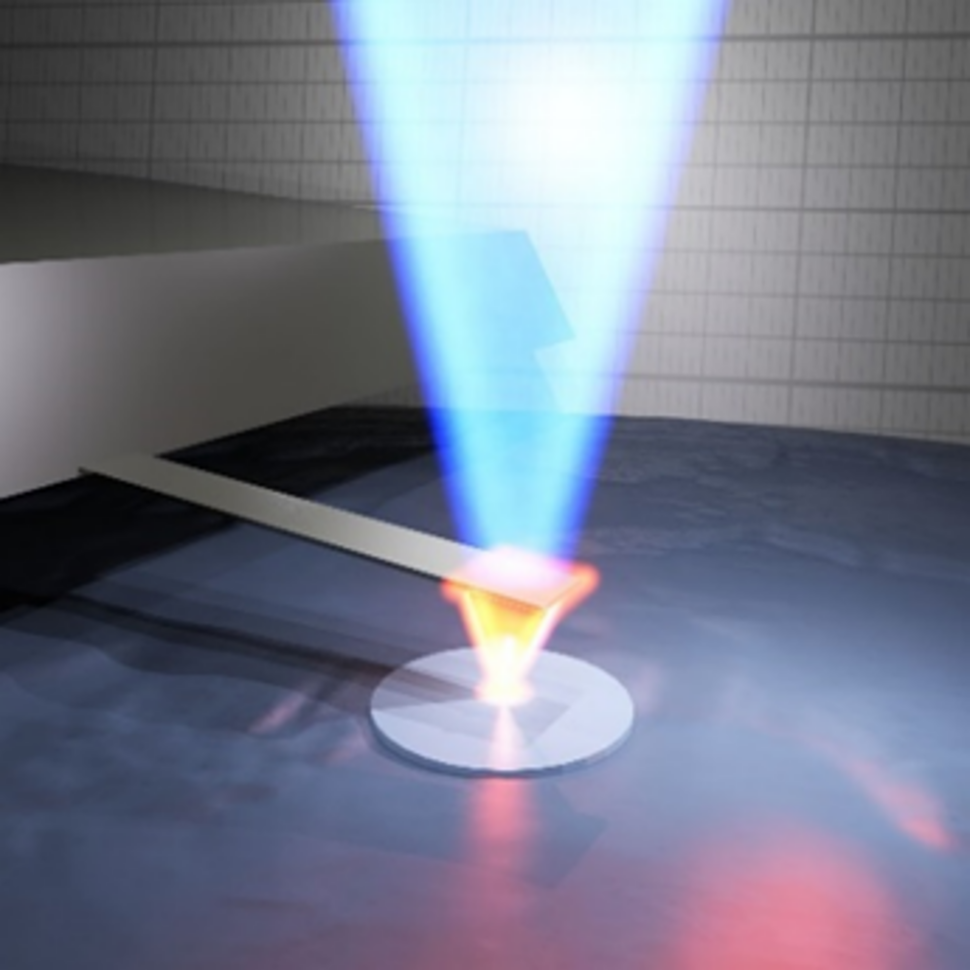
By aligning a UV laser perpendicular to an atomic force microscope cantilever it becomes possible to concurrently measure all different sorts of functional properties in contact mode as they vary with temperature. This approach offers valuable insights into the localized characteristics of phase transitions. Additionally, this technique can be utilized to measure the local thermal conductivity.
Of particular interest, it is the combination of thermally modulated cantilevers with nanomechanical measurements, using for example contact ressonance frequency AFM or pieroelectric measurements utilizing band excitation piezoresponse spectroscopy.
Features
Available modes:
- Scanning Thermal Microscopy (SThM)
- Thermic Probe Microscopy (ThAFM)
- Thermal lithography
Specifications
- Sample size: 12×12 mm
- Scan range: 30×30 um
- Z height limit: <10 µm
- Temperature range: 25-500C
- Compatible with automated experiments
Applications
Local Curie temperature in ferroelectric materials
Local melting and glass transition temperature in polymers
Reversible and irreversible thermal processes
Equipment
Asylum Research Cypher AFM
References
Anna N. Morozovska, Eugene A. Eliseev, Kyle Kelley, and Sergei V. Kalinin, “Temperature-Assisted Piezoresponse Force Microscopy: Probing Local Temperature-Induced Phase Transitions in Ferroics” Phys. Rev. Applied 18, 024045 https://doi.org/10.1103/PhysRevApplied.18.024045
Kyle P. Kelley, Sergei V. Kalinin, Eugene Eliseev, Shivaranjan Raghuraman, Stephen Jesse, Peter Maksymovych, Anna N. Morozovska “Probing Temperature-Induced Phase Transitions at Individual Ferroelectric Domain Walls” Adv. Elec. Mater, 9(1):2200552, 2023 https://doi.org/10.1002/aelm.202200552
M.Checa, K.P Kelley, R Vasudevan,L Collins and S Jesse, “Automated piezoresponseforce microscopy domain tracking during fast thermally stimulatedphasetransitioninCuInP2S6” Nanotechnology 34(2023)325703 https://doi.org/10.1088/1361-6528/acd34d