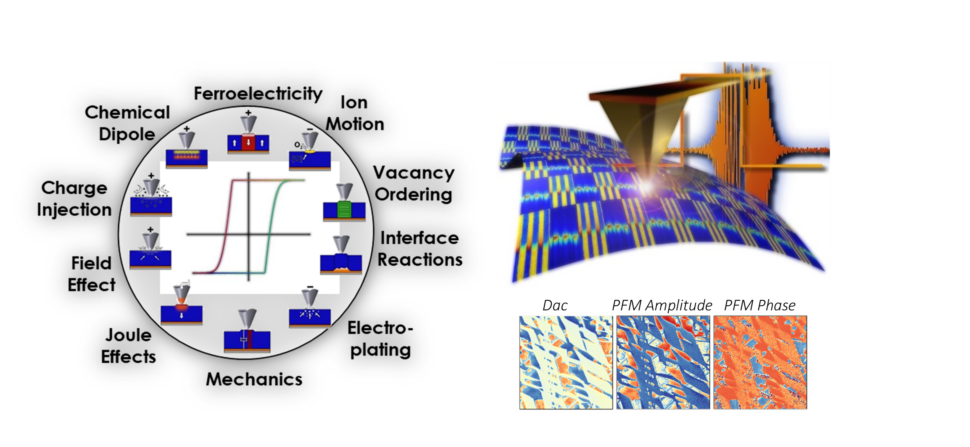
Piezoresponse Force Microscopy is used to detect mechanical responses of an AFM tip used as a top electrode when an electric signal is applied to it to excite the sample. In spite of the fact that the primary response is obtained from piezo and ferroelectric materials via the inverse piezoelectric effect, this technique can been applied to study a wider range of nanoscale electromechanical phenomena, such as ionic motion or defects ordering in crystalline materials.
Features
Available modes:
Piezoresponse force microscopy (PFM) measures the local electromechanical deformation in response to an AC voltage applied through the tip. The strength of the piezoresponse and the polarity of the polarization can be extracted from the amplitude and phase signals, respectively.
Switching spectroscopy PFM (SS-PFM), a DC voltage is applied typically to induce polarization switching in ferroelectric materials while the piezoresponse during and between DC triangle square pulses is measured and recorded. PFM hysteresis loops can be measured using SSPFM.
Contact Kelvin probe microscopy (cKPFM) is similar to SSPFM with the difference that over multiple cycles a varying DC read voltage is applied between the write pulses that are applied to change the polarization. This approach helps to distinguish between real ferroelectric switching and electrostatic artifacts.
Quantitative PFM utilizes electrostatic blind spots along the cantilever mode shape, or intrinsically calibrated measurement of tip displacement utilizing interferometric detection. These modes are less prone to electrostatic influences, leading to more reliable investigations of ferroelectricity and allow quantification off effective piezoelectric coefficients on the nanoscale
Thermal PFM (ThPFM) enables to measure electromechanical properties under local heating conditions induced by laser thermal control of the tip.
Specifications
Sample up to buffer size
Scan range (30×30 um, 80×80 um)
Z height limit (<10 µm)
Environmental Control
Glove box (Ar filled)
Environmental cells for gases: humidity, nonreactive