Designing Biological Systems for a More Resilient Future
Scientists in the Biological Systems Design Group engineer proteins, microbes, and plants to better understand and influence complex biological processes that underpin living systems and their interactions with the environment. Their research combines principles from biology, engineering, computational science, and biotechnology to develop new approaches for studying and designing biological functions across multiple scales.
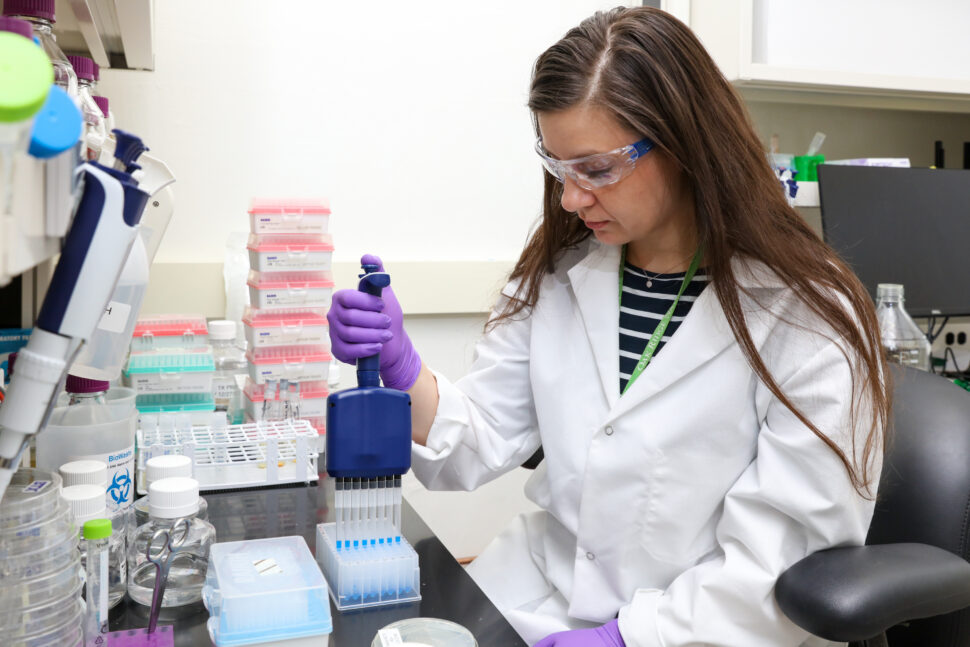
Microbiologist Delyana Vasileva works in a lab. The Biological Systems Group create engineering tools that enable the design and modification of biological systems. Credit: ORNL / U.S. Dept. of Energy
The group conducts research ranging from individual proteins and cells to complex communities of organisms and entire ecosystems. At the molecular level, scientists engineer proteins with specific properties to regulate biological activities, improve metabolic performance, or enable new functions within cells. These efforts help reveal how biological systems operate while providing tools that can be applied to challenges in agriculture, manufacturing, critical minerals recovery, and the environment.
Researchers also design and study microbes and microbial communities, or microbiomes, that interact with plants, other organisms, and the environment. By understanding and programming these interactions, the group seeks to develop beneficial microbial systems to enhance plant growth, improve resilience to environmental stress, and isolate critical minerals. Such advances contribute to more reliable and efficient sources of feedstocks for manufacturing applications.
Plant Systems Technical Professional Leah Hochanadel performs a greenhouse experiment. Credit: ORNL / U.S. Dept. of Energy
A major focus of the group’s work is the creation of foundational engineering tools that enable the precise design and modification of biological systems. These include methods for genetic engineering, predictive modeling, biological measurement, and data-driven design. Together, these capabilities support the development of organisms and biological processes with characteristics tailored for specific applications.
Through collaboration with partners across national laboratory, academic and industry sectors, the Biological Systems Design Group advances both fundamental scientific understanding and practical biotechnology solutions. The knowledge, tools, and engineered systems developed by the group support efforts to expand domestic manufacturing capabilities and advance the production of high-value chemicals, materials, and other products, strengthening scientific and technological foundations needed to support innovation and national competitiveness in emerging areas of the economy.