Multi-scale Modeling of Molecular Processes
The Molecular Biophysics Group at Oak Ridge National Laboratory uses high-performance computer simulation, machine learning, deep learning-based structure prediction, and other computational approaches to explore the molecular mechanisms underlying numerous biological processes. Understanding the three-dimensional structure, function, and dynamics of biological macromolecules drives discoveries in molecular biology, environmental science, bioenergy, and biomedical research. The group focuses on modeling and simulation methods development, cell membrane simulations, protein/enzyme engineering and therapeutic discovery.
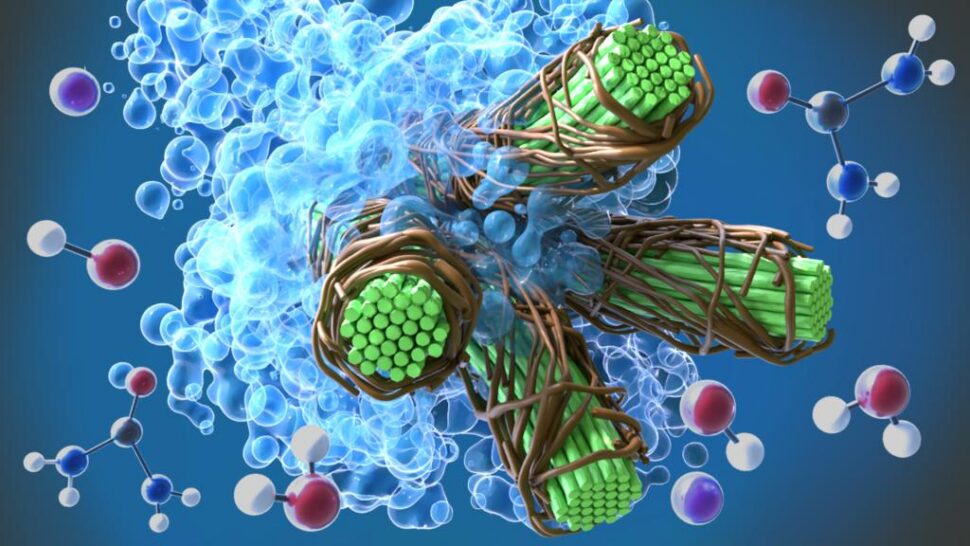
In bioenergy-related research, researchers in the group investigate the molecular forces that stabilize lignocellulosic biomass in plants. Understanding these forces is crucial for optimizing biomass pretreatment processes that directly impact the efficiency of bioenergy and biomaterial production.

In biomedical research, the group focuses on therapeutic discovery and design. The team applies structure-based approaches and advanced machine learning techniques to enhance predictions of ligand binding, informing the discovery of new inhibitors. The team’s drug design efforts have led to the discovery of molecules that are active against many different targets. Researchers also leverage enhanced sampling methods to simulate protein dynamics to develop targeted therapeutic interventions.
The team employs ORNL supercomputing resources at the Oak Ridge Leadership Computing Facility, and uses simulation methods to interpret experimental data obtained from neutron scattering experiments conducted at the Spallation Neutron Source. Collaborative efforts are enhanced through close partnership with the ORNL-University of Tennessee Center for Molecular Biophysics.
Researchers




Publications
Aug, 2026
Journal
Role of electron correlation on the adenine dimer interaction for non-equilibrium geometries: a benchmark Quantum Monte Carlo study
The accurate description of non-covalent interactions is critical for understanding the structure, dynamics, and eventual function of biomolecules. The adenine dimer serves as a benchmark system for computational methods due to its role in nucleic acid structures and its rich conformational landscape. In this study, we employ benchmark diffusion quantum Monte Carlo (DMC) m…
Aug, 2026
Journal
Molecular origin of anisotropic shear elastoplasticity in chitin
Chitin nano- and mesoscale structures present in the exoskeleton of crustaceans exhibit exceptional longitudinal stiffness and toughness, rivaling or even exceeding that of many synthetic polymer architectures. Here, we reveal the origin of the asymmetric shear response in chitin multiscale architectures, marked by pronounced anisotropy in deformation. Under shear aligned…
Jun, 2026
Journal
Solvent-Mediated Control of Nanocellulose Dispersion: An Integrated Computational and Experimental Investigation
Fibrillated cellulose derived from forestry feedstocks represents a renewable and high-strength materials platform for circular bioeconomies. However, its practical implementation is hindered by the irreversible aggregation of nanocellulose architectures, including cellulose nanofibers (CNFs). Solvent-based dispersion offers a simple and practical route to prevent CNF aggr…
Contact