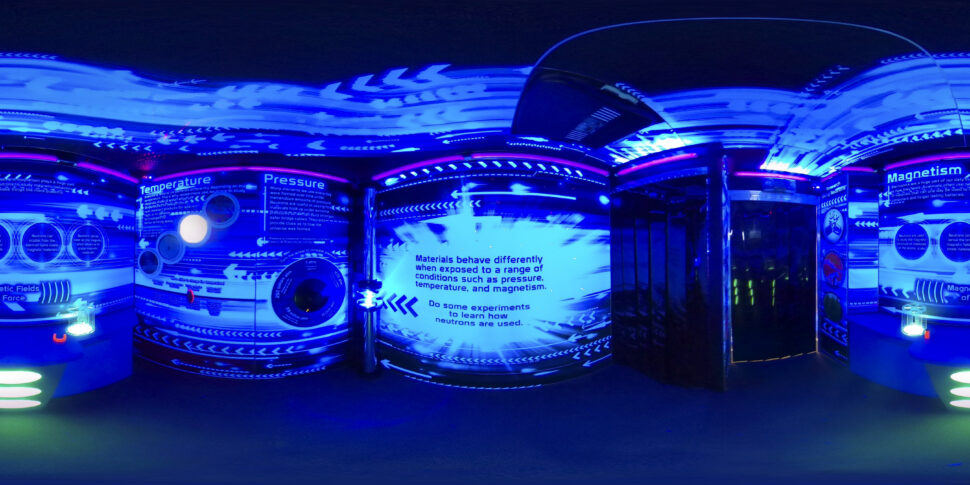
Become a Neutron takes students inside the science of neutron scattering at Oak Ridge National Laboratory. Through an interactive journey inspired by ORNL’s Spallation Neutron Source, students discover how researchers use neutrons to study materials at the atomic scale.
Explore Neutron Science
Neutrons are subatomic particles found in nearly every atom. Scientists at Oak Ridge National Laboratory use neutrons to investigate the positions, motions, and magnetic properties of atoms inside solids, liquids, gases, and other materials.
By studying how neutrons interact with materials, researchers can learn things that would be difficult to observe in other ways.
How Neutron Scattering Works
In neutron scattering experiments, scientists direct neutrons toward a sample. Some neutrons pass through the material, while others scatter from atomic nuclei—similar to balls colliding in a game of pool.
Special detectors record how the neutrons scatter. Researchers use that information to investigate materials ranging from proteins and plastics to metals, magnets, and superconducting ceramics.
These experiments help scientists understand materials at the atomic scale and contribute to research relevant to technologies such as computing, medicines, batteries, and advanced materials.
Neutron Science at ORNL
Oak Ridge National Laboratory is home to two major neutron research facilities: the High Flux Isotope Reactor (HFIR) and the Spallation Neutron Source (SNS).
Scientists from around the world come to Oak Ridge to use these facilities to study materials and answer research questions across many areas of science.
Research at these facilities brings together scientists and other STEM professionals who operate research instruments, conduct experiments, analyze data, and help turn scientific questions into discoveries.
What You’ll Do in the Exhibit
Students “become a neutron” and follow its path from the ion source to the science instruments at the Spallation Neutron Source, with ORNL scientists guiding the journey along the way.
Along the route, students explore a sample environment and learn how researchers use extreme temperatures, pressures, and magnetic fields to study materials with neutron scattering.
The experience concludes with an experiment simulator where students select a sample, collect data, and visualize their results—giving them a glimpse of how neutron scientists conduct experiments and interpret scientific data.
Explore STEM Careers
Neutron research involves people with a range of STEM skills, from conducting experiments and operating scientific instruments to analyzing data and studying how materials behave.
As students move through the exhibit, they experience several parts of the research process and see how scientific questions, specialized facilities, technology, and people work together to produce new knowledge.