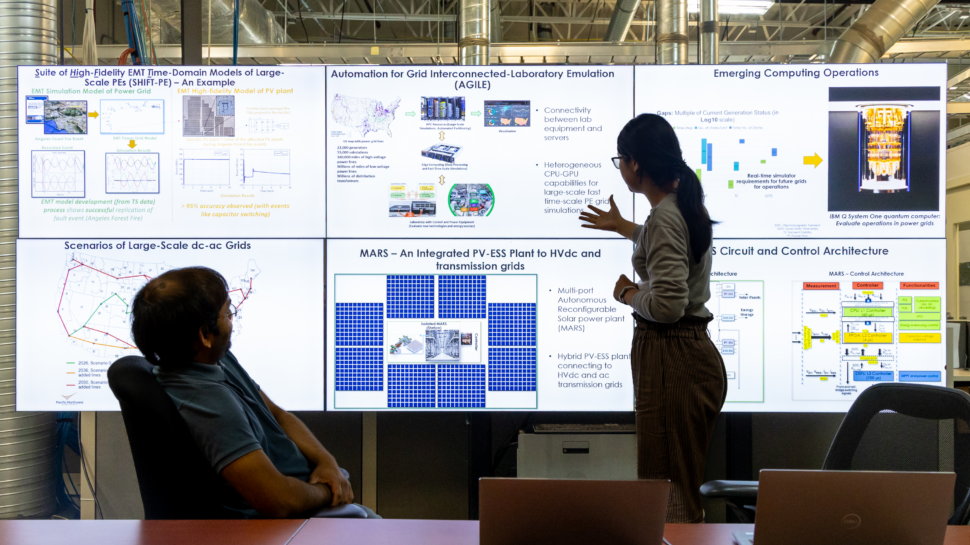
The Advanced Computing Laboratory provides access to high-performance computing resources and software needed to perform large-scale, high-fidelity simulation of power grids with power electronics for planning and operations, as well as to train artificial intelligence/machine learning (AI/ML) algorithms for monitoring power grids. It can also be used to create digital twins and for connectivity to the Real-Time Simulation Laboratory co-located in ORNL’s Grid Research Innovation and Development Center (GRID-C).
The power grid in United States is transitioning to integrate faster-acting power electronics components, high-fidelity sensors, fast communication, and high-performance computing resources (both in control centers and at the edge). As this transition happens, high-fidelity modeling and simulation – such as electromagnetic transient simulation –along with AI/ML algorithms will be necessary to plan and maintain reliable, resilient, stable, and secure operation of the power grid. The Advanced Computing Laboratory provides crucial resources that can help utilities and system operators to plan and operate power grids of the future.
Uniqueness and capabilities
Perform electromagnetic transient (EMT) simulation of large power grid.
Simulate large-scale and complex power electronics with power grid models.
Train AI/ML for monitoring power grids, taking predictive actions, and preventing cyberattacks.
Plan future power grid with power electronics/reliability studies.
Connect to Real-Time Simulation Laboratory to evaluate individual equipment (controls or protection) under realistic operating conditions.
Technology resources
CPU-GPU heterogeneous servers
Visualization
Ethernet connectivity to Real-Time Simulation Laboratory
For more information about the Advanced Computing Lab, contact Suman Debnath.