Addressing Complex Water-Energy Resource Challenges
Scientists in the Biodiversity and Ecosystem Health group at Oak Ridge National Laboratory address the intricate and interconnected challenges surrounding water and energy resources. These scientific challenges include the need to understand and predict environmental responses to energy production, develop scientifically sound technologies that can enhance energy security and minimize environmental impacts, and provide society and stakeholders the information and tools necessary to inform policy and decision-making.

The team’s research explores these crucial scientific issues by providing in-depth knowledge, innovative technical solutions, and predictive capabilities that significantly advance understanding of ecological and environmental responses associated with various forms of energy production, including hydropower, fossil fuels, biofuels, and nuclear energy. The group also strives make accurate, actionable information and technical resources accessible to policymakers, stakeholders, and society at large.
One of the group’s primary objectives is to thoroughly understand and predict how different energy production strategies impact ecological systems. Researchers investigate complex interactions between energy generation processes and environmental health, assessing how these interactions affect biodiversity, water quality, and ecosystem services. The goal is to generate comprehensive insights that can inform environmental management practices and policy development, thereby promoting energy production while minimizing environmental disruption.
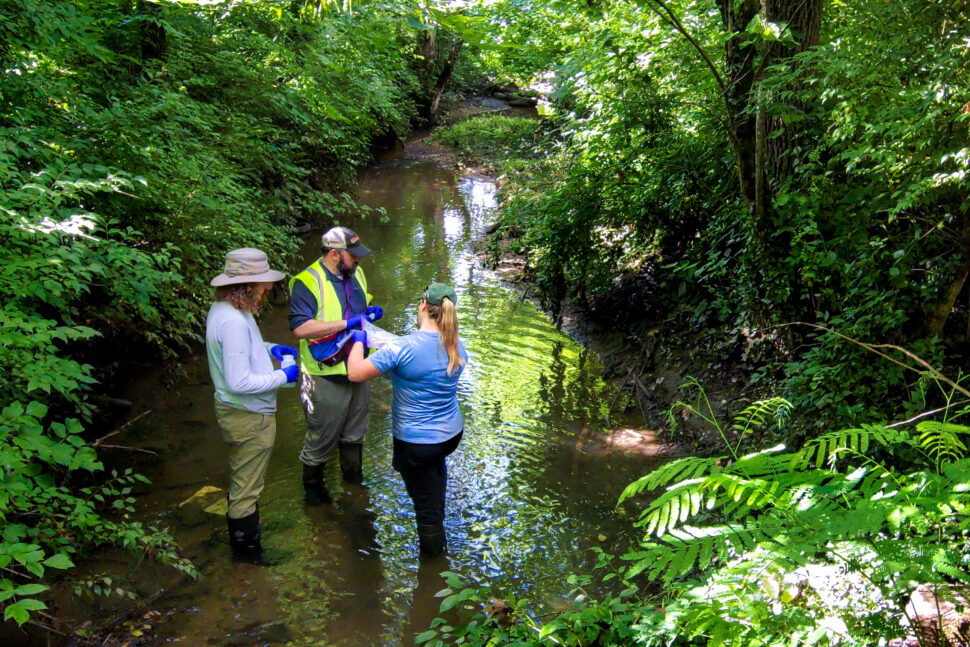
With the aim of enhancing national energy security, the group actively develops scientifically robust technologies designed to mitigate ecological impacts. These innovations are created through rigorous scientific methods, incorporating interdisciplinary approaches that span ecology, hydrology, biology, and environmental engineering. The practical tools and technologies developed are geared towards boosting energy production while improving resource management, ecological restoration, and environmental preservation.
Central to the group’s research capabilities are specialized resources such as the 8,000 square foot Aquatic Ecology Laboratory, which facilitates controlled and precise experimental research in simulated aquatic environments. Additionally, researchers employ long-term ecological evaluations at various field sites, generating invaluable datasets that inform predictive ecological modeling. The creation and maintenance of comprehensive national geospatial databases and advanced ecological modeling tools further enhance the group’s ability to address water-energy resource challenges at local, regional, and national scales, supporting a balanced approach to energy development and environmental conservation.
Aquatic Ecology – Current Research and History
Researchers
















Publications
Dec, 2026
Journal
Effects of PFOS on the behavior, growth, emergence, and predation susceptibility of larval mosquitoes (Culex quinquefasciatus)
Per-/polyfluoroalkyl substances (PFAS) have been commonly used over several decades for a variety of products and are very persistent in the environment. However, not much is known about their direct effects on aquatic invertebrates and their ecosystems. We examined the survival, behavior, development, and predation susceptibility of mosquito larvae Culex quinquefasciatus…
Oct, 2026
Journal
Spatiotemporal shifts in composite weather stress across US croplands
Weather stressors influence crop production, farm management, and long-term agricultural suitability across the United States. These stressors vary across agricultural regions. While numerous weather indices exist, a generalized metric tailored to a region’s specific agricultural context remains lacking. Here, we introduce a multi-stressor framework that integrates 32 weat…
Sep, 2026
Journal
The Zooplankton International Geospatial dataset: A global repository of spatiotemporal freshwater zooplankton community composition data from lakes and reservoirs to support ecological research
Zooplankton transfer substantial energy in aquatic food webs and are used as indicators of environmental change. Syntheses of zooplankton community dynamics globally require datasets that span a wide range of environmental gradients; however, these datasets are limited due to methodological differences across programs, taxonomic inconsistencies, and a lack of standardized…
Contact