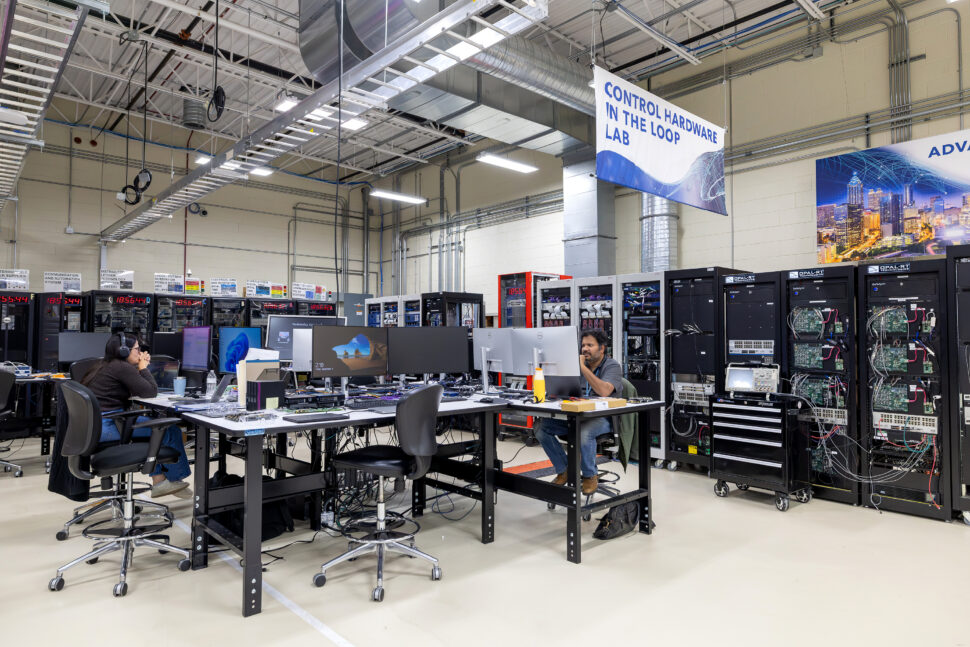
The Real-time Grid Simulation Laboratory combines software and hardware for evaluating power distribution systems and power electronics using different architectures and communication and protection approaches.
The U.S. electric grid must be modernized to handle multi-directional power flow from multiple energy sources and additional capacity and variability for electric vehicle charging. Industry partners such as utilities are seeking more tools for ease of integration, resiliency improvements, and protecting cyber/physical resources from attack or manipulation. Real-time systems are ideal for developing and validating tools and algorithms.
Uniqueness and capabilities
Simulating large-scale and complex power electronics systems. Capability to test communication interfaces like fiber, controller area network (CAN), and Modbus to simulators.
Integrating power electronics systems to distribution feeders and performing impact analysis.
Utilizing a unique platform to validate communication protocols, hierarchical controls, and protection.
Testing advanced algorithms for power electronics systems and distribution grids.
Testing cybersecurity approaches using commercial-grade substation hardware.
Technology resources
Simulator test beds with analog/digital expansion boxes to connect more than 15 protective relays in-the-loop and offer grid modeling with approximately 10,000 nodes.
Communication test bed for solid state power station (SSPS).
Extended capability to intertie multiple simulators through Peripheral Component Interconnect Express (PCle) links.
Controller hardware in loop (CHIL) test beds for hierarchical systems with agents for converter/resource integration.
Electrical substation grid with test bed for distributed energy resources, using Distributed Ledger Technology to improve communication security between electrical utilities.
Commercial relay test systems, intellirupter interface, and current/voltage amplifiers to assess power system protection devices and schemes.
For more information about the Real-time Simulation Lab, contact Ben Dean.