Atomic Processes Control Ductility of Metallic Glasses
Share
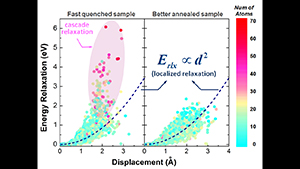
For metallic glasses with different cooling histories, deformation modes may differ. For the more annealed sample at right, deformation is localized and only yields one energy relaxation mode. For the fast-quenched sample a left, however, in addition to an identical localized deformation, a cascade deformation mode also exists and involves a larger number of atoms (right bar).
A novel simulation of metallic glasses demonstrates that atomic relaxation modes during deformation depend on the density of local minima in the systems’ underlying potential energy landscape (PEL). The relaxation is mostly localized in a slowly cooled glass, but shows an extra delocalized feature (through a cascade process) in a rapidly quenched glass. This study suggests an avenue to improve ductility of metallic glasses—a long-standing challenge—through the control of the PEL and cooling histories.
Thermally activated local deformation is investigated in two simulated metallic glass samples prepared with different cooling histories. Two deformation modes—a localized process and a cascade process—have been identified. The localized deformation involves fewer than 30 atoms on average and appears in both samples, and its size distribution is invariant of cooling history. However, the cascade deformation is much more frequently observed in the quickly quenched sample than in the slowly quenched sample. The origin of the cascade process in the fast-quenched sample is attributed to the higher density of local minima in the underlying PEL. Because cascade deformation enables more efficient-energy dissipation, a quickly quenched sample has higher ductility than the slowly annealed sample.