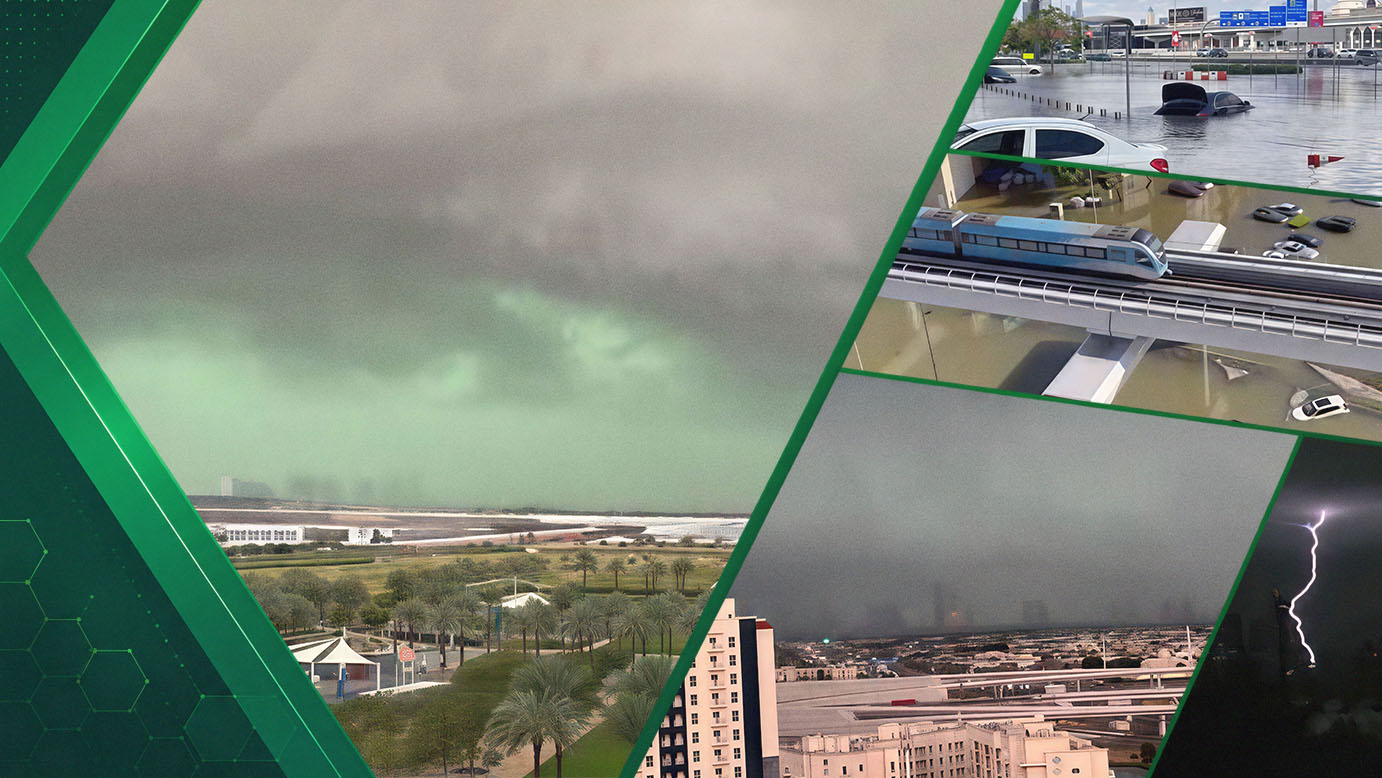
Scientists at the Department of Energy’s (DOE) Oak Ridge National Laboratory (ORNL) identified a record-breaking atmospheric river as a key driver of catastrophic flooding in the United Arab Emirates (UAE) and surrounding Gulf region in April 2024, advancing understanding of extreme rainfall in some of the world’s driest climates. Atmospheric rivers are narrow corridors of concentrated moisture that transport large amounts of water vapor and can produce intense precipitation when they reach land.
The findings, published in the Bulletin of the American Meteorological Society, show that an exceptionally intense corridor of atmospheric moisture transported vast amounts of water vapor into the region, setting the stage for the historic storm.
“Until now, studies on this storm focused mainly on intense, localized thunderstorm clusters and high-altitude atmospheric disturbances as the main culprits,” said ORNL researcher Elias Massoud, who worked on the project. “What we discovered was the presence of a massive atmospheric river. It acted like a giant conveyor belt, pulling in moisture from hundreds of miles away and feeding it directly into the region. We consider this a truly record-breaking event because the atmosphere above the UAE and surrounding areas held more water vapor than has ever been recorded there. That unprecedented surge of moisture played a critical role in producing such extreme rainfall.”

Using advanced atmospheric river detection techniques, ORNL’s expertise in data analytics and a tracking algorithm developed alongside partners at the University of California, Los Angeles and the NASA Jet Propulsion Laboratory, the study reported that moisture transport during the weather event, which took place spring of 2024, reached record levels compared with historical observations. Parts of the UAE received more than 100 millimeters of rain — more than 170 percent of the country’s average annual rainfall in just three days. The resulting floods disrupted transportation, damaged infrastructure and caused significant economic losses across the Gulf region.
While previous studies examined the storm primarily through the lens of convective weather systems and upper-level atmospheric dynamics, this analysis shows that an atmospheric river supplied the concentrated moisture that intensified the storm and amplified the record-breaking rainfall. The ORNL-led team used specialized domain expertise to connect the dots, recognize the signature of a record-breaking atmospheric river, and prove its role. The findings demonstrate how atmospheric river analysis can complement traditional forecasting approaches and improve understanding of extreme precipitation in the Middle East and other regions.
“Atmospheric rivers are often the hidden drivers behind major disasters,” Massoud said. For example, most people don’t realize that days before Hurricane Helene hit the Southeast, an atmospheric river had already completely saturated the ground, setting the stage for widespread damage. But the impact of atmospheric rivers goes far beyond extreme flooding. These massive storms also devastate ecosystems by triggering mass vegetation die-offs and disrupt global transportation by shifting Arctic navigation routes. Understanding how atmospheric rivers contribute to these conditions vastly improves our forecasting and emergency preparations.”
The study reflects ORNL’s growing leadership in Earth system science, where researchers combine atmospheric science, advanced computing and data analytics to better understand extreme weather and improve predictive capabilities. Such research supports efforts to strengthen infrastructure resilience and improve forecasting and help inform infrastructure planning and emergency preparedness for extreme weather.
The research was led by ORNL’s Elias Massoud in collaboration with Bin Guan of the University of California, Los Angeles, NASA’s Jet Propulsion Laboratory, and Theresa Massoud of Education Pathways Dubai in the UAE.
UT-Battelle manages ORNL for the Department of Energy’s Office of Science, the single largest supporter of basic research in the physical sciences in the United States. The Office of Science is working to address some of the most pressing challenges of our time. For more information, please visit energy.gov/science.
