

Bio
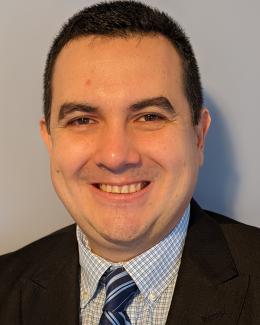
Dr. William F Godoy joined ORNL in 2016, and is currently a Senior Computer Scientist in the Computational Science and Mathematics Division, CSMD. A native of Peru, his background is in Mechanical Engineering with research interests on high-performance computing (HPC), programming models, scientific software, workflows, and AI for HPC.
Dr. Godoy obtained his PhD (2009) and MS (2006) degrees from the State University of New York at Buffalo, working under the supervision of Dr. Paul E. DesJardin on 3D radiative transfer parallel computational models. Before ORNL, he worked as a Senior Software Engineer at Intel Corporation (2012-2016) and a postdoctoral fellow at NASA Langley (2009-2012) on Jacobian-Free Newton Krylov methods and GPU solutions for radiative transfer.
At ORNL, Dr. Godoy contributed to the US Department of Energy (DOE) Exascale Computing Project (ECP) as (i) the architect and core developer of ADIOS 2, the Adaptable Input Output System version 2, (ii) contributor to the QMCPACK software, and (iii) researching the LLVM-based Julia language for HPC under PROTEAS-TUNE - which led to a best paper at WORKS SC23 and a first paper on applying large language models (LLMs) to HPC. He also worked on improving the file loading times and performance of data reduction workflows impacting users at ORNL neutron science facilities: SNS and HFIR.
Dr. Godoy is currently funded by the US DOE Advanced Scientific Computing Research (ASCR) serving as co-PI of S4PST and member of PESO, funded by the ASCR Next Generation of Scientific Software Technologies project, as co-PI of a EXPRESS project on power models for novel hardware, and as co-PI of the Ellora AI4Science project leveraging LLMs for HPC software. He also serves as a mentor on several internship programs and technical committees. He is a senior member of IEEE, and a member of ACM.
Professional Experience
2022-Present Senior Computer Scientist, Computer Science and Mathematics Division, ORNL
2016-2021 Computer Scientist, Computer Science and Mathematics Division, ORNL
2012-2016 Senior Software Engineer, Process Technology Modeling, Intel Corporation
2009-2012 Postdoctoral Fellow, NASA Langley Research Center
2004-2009 Research Assistant/PhD Student, SUNY Buffalo
Awards
Most Innovative Accomplishment Team Award for ChatBLAS, CCSD Annual Awards, 2025
Best Paper, SC24 XLOOP: 6th Annual Workshop on Extreme-Scale Experiment-in-the-Loop Computing, 2024
Best Research Poster Finalist for JACC.jl, SC24, 2024
Best Tutorial, Performance Portability on Julia with JACC.jl, ORNL Software Expo, 2024
Outstanding Mentor Award, CSMD 2023
Best Paper, SC23 WORKS: 18th Workshop on Workflows in Support of Large-Scale Science, 2023
Better Scientific Software Fellowship, Honorable Mention, 2022
Director Division Award, CSMD, 2021
Most Integrated Project Award, Ugly Data Days, CSMD/SNS, 2018
Supplementary Performance Award, CSMD, 2017
Department Recognition Award, Process Technology Modeling, Intel Corporation, 2014
NASA Postdoctoral Fellowship Award, 2009
Professional Affiliations
IEEE Senior Member
ACM Member
ASME Member
US-RSE Member