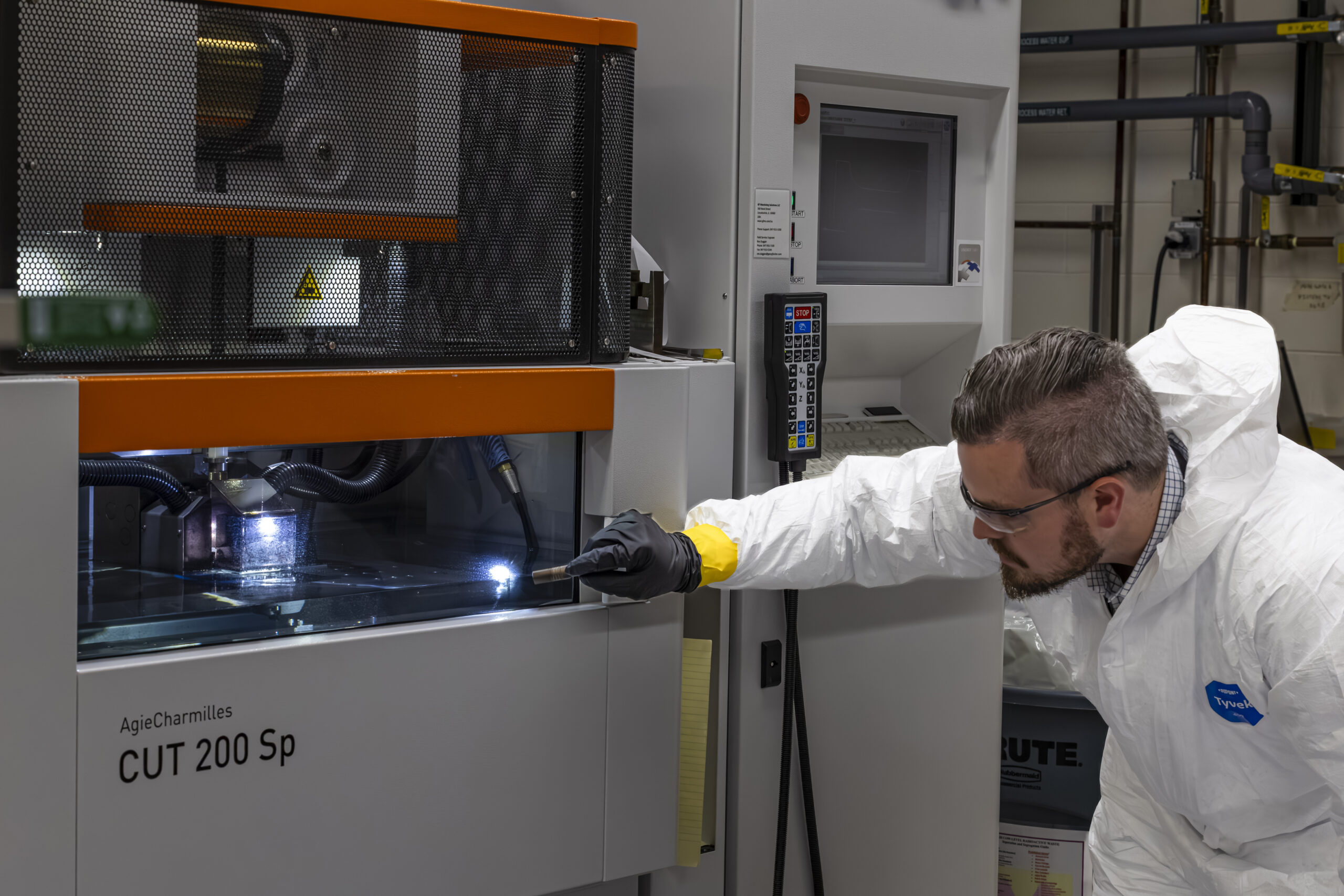
The nuclear industry is entering a pivotal and promising new era. Growing energy demand and advances in artificial intelligence are driving innovation across the nuclear sector. At Oak Ridge National Laboratory, researchers at the forefront of next-generation nuclear reactor design development are exploring advanced manufacturing methods, including 3D printing. The team is already seeing strong potential to produce safer, more efficient components built to perform in the most extreme environments.
Working within ORNL’s Nuclear Fuel Materials Group, Caleb Massey studies how nuclear core and structural materials perform when exposed to radiation in nuclear reactors. From designing new metal alloys to examining irradiated materials, his work reveals unique insight into how additive manufacturing could fast-track the future of advanced nuclear reactors.
Q: Why does testing new nuclear materials take so long?
A: Qualifying a new nuclear material takes time because significant experimentation is required to prove their safety in a multitude of environments. Nuclear materials need to withstand both the intense irradiation fields and the corrosive environments expected for each type of nuclear reactor, and identifying test environments that can replicate these conditions is complex. While there are several research reactors across the U.S. that are irradiating prospective materials to help generate new design data, these experiments take a while to conduct because research reactors represent different operating conditions from the proposed operating conditions of some advanced reactor designs.
This is one reason why DOE’s Advanced Reactor Demonstration Program is vital to bringing new nuclear online. National laboratories like ORNL are partnering with industry to build demonstration reactors to help validate the safety of new reactor designs that can supplement data we’re producing using our current DOE capabilities.
Q: What is unique about qualifying 3D printed materials vs. conventional manufactured materials?
A: 3D printed materials for nuclear reactors have the potential to shorten timelines for building complex nuclear components. Pump housings, valves, compact heat exchangers and other parts have lead times commonly measured in years when additive manufacturing can produce these parts in months or weeks. However, qualifying these materials is infinitely more complex.
Conventionally manufactured materials are often qualified under the assumption that materials made through a specific process will have the same properties everywhere within that material. This means that data from a sample specimen from a giant piece of material is representative of the rest of the material. With less variables to consider, this assumption greatly simplifies testing.
Meanwhile, 3D printed materials can have performance variations throughout one component, since the boundary conditions driving solidification pathways are dependent on the surrounding component geometry and temperature conditions. So, we design experiments that examine how much variance in properties we might expect within a larger component. This would be like testing each block in a large assembly of Legos to confirm its performance.
3D printing’s main advantage over conventional manufacturing is the ability to make unique component designs/shapes. Still, unique shapes can be harder to gather testing specimens from. Qualifying these more complex geometries demands incorporating new methods into existing codes and standards to allow for unique means of non-destructive examination or the use of non-standard test specimens to generate data.
Q: How can advanced modeling or simulations speed up testing?
A: Modeling can be used in two unique ways to speed up the testing of advanced and conventionally manufactured materials.
First, researchers use very powerful models that can simulate material deformation, even if material properties vary in different applications of stress. These models need careful calibration, but they can reduce testing to mostly one direction. From that, the models can predict how the material would perform in any direction
We’re also applying AI to conduct smarter sample testing. For example, instead of having to perform thousands of high-temperature mechanical tests to validate models, AI models can identify exactly which tests to conduct and at what stage while maintaining the same margin of error in our experimental predictions with only a small subset of test conditions. Fewer, more accurate tests accelerate the timeline for qualifying new materials.
How does your research aim to accelerate qualification of these materials?
A: My research is tackling three major obstacles to help speed up the qualification of additively manufactured materials. First, our team is working to accelerate processing parameters, or the specific conditions necessary to develop materials through new manufacturing pathways. We have a unique capability to do this at ORNL’s Manufacturing Demonstration Facility, where we’ve outlined the microstructures of several types of materials and how their mechanical performance would be impacted by hundreds of different processing parameters. Once we have established an allowable performance window for the unirradiated material, I then develop irradiation campaigns at ORNL’s High Flux Isotope Reactor where we can rapidly irradiate new material variants to establish how exposure to radiation will impact a material’s performance.
I also collaborate with regulatory and standards bodies to establish what types of performance data on irradiated specimens will be needed for their eventual acceptance as nuclear-qualified structural materials.
Q: What impact might 3D printed materials and faster qualification of those materials have on the pace of nuclear innovation?
A: 3D printed nuclear materials have the potential to solve critical supply chain issues for the nuclear industry while simultaneously enabling the artificial intelligence revolution within the U.S. Using 3D printing, we can vastly shorten construction timelines by simplifying the production of geometrically complex components for each type of reactor. Accelerating the pace of manufacturing will be advantageous, especially as we consider small modular and microreactor designs as dedicated power sources for AI data centers. These more compact reactor designs have more complex geometries which can require more difficult assembly, maintenance, welding and repairs. A robust supply chain of qualified 3D printing methods and materials will help alleviate these challenges and enable nuclear solutions to support the growing AI power demand.
This research was funded by the Advanced Materials and Manufacturing Technologies Program within the U.S. Department of Energy, Office of Nuclear Energy.
UT-Battelle manages ORNL for DOE’s Office of Science, the single largest supporter of basic research in the physical sciences in the United States. The Office of Science is working to address some of the most pressing challenges of our time. For more information, please visit energy.gov/science.
Related Researchers