Haswitha Sabbineni has an idea that could lead to a targeted treatment for prostate cancer.
To get the rare isotope she needed to test it, she turned to the Department of Energy’s (DOE) Oak Ridge National Laboratory (ORNL). The lab is one of the few places in the world capable of making many specialized isotopes — among them, rhenium-188 (Re-188), which is produced when tungsten-188 (W-188) undergoes radioactive decay.
A graduate student at Vanderbilt University School of Medicine, Sabbineni is building on the research of her mentor Nancy Carrasco, a professor in Vanderbilt’s Molecular Physiology and Biophysics department, and colleague Alejandro Llorente-Esteban, who earned his doctorate in Carrasco’s lab. Thirty years ago, Carrasco’s lab had a breakthrough, cloning the DNA coding for a specific protein — the sodium/iodide symporter (NIS) — that successfully carries targeted radioactive iodine treatments to thyroid cancer cells. Llorente-Esteban generated a modified NIS molecule that could be used to treat cancers outside the thyroid without harming the thyroid. Sabbineni is now investigating whether this strategy can be used to treat prostate cancer in a mouse model.
But to actually test it, she needed radioactive perrhenate, which contains Re-188. The perrhenate molecule is transported by NIS.
“We were eager to get it to test our hypothesis,” Carrasco said.
ORNL makes W-188 by irradiating W-186 in the High Flux Isotope Reactor (HFIR) — a DOE Office of Science user facility that is one of the world’s most powerful research reactors and a cornerstone of U.S. isotope production. The lab has the capability to make “generators,” columns of W-188 from which Re-188 can be eluted, an example of translating reactor-based innovative discovery science into practical tools for medical research.
The only problem: ORNL last made a tungsten-rhenium generator in 2011.
But Becca Hoerres was up for reviving — and modernizing — the technology.
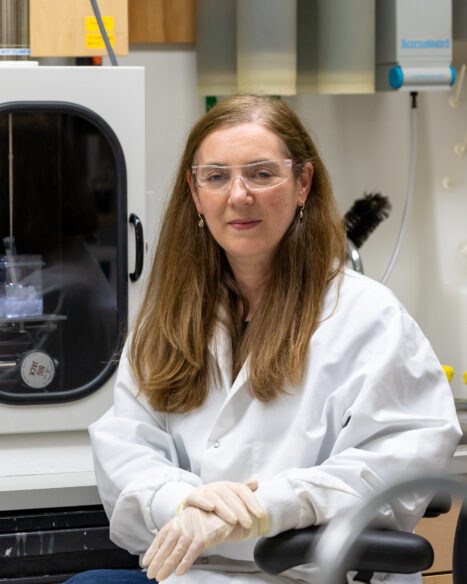
Hoerres is an associate radiochemist in ORNL’s Medical Isotope Group. She came to ORNL two years ago as a postdoctoral student working on actinium-225, another medical isotope used in cancer treatment, and eagerly took on the challenge of resuming Re-188 production.
“I love the people and the atmosphere at ORNL,” Hoerres said. “It’s very collaborative, and there are always opportunities to explore new ideas.”
Hoerres admitted she’s “kind of a sucker for Re-188,” which her graduate work involved.
“It’s a great isotope,” she said. “So, this was kind of a fun project for me — it was like a continuation of what I’d been doing.”
Potential to treat multiple cancers
Re-188 is already used for a noninvasive skin cancer treatment, in which it’s painted onto the skin, and it’s being investigated for treating multiple other kinds of cancer. DOE’s Office of Isotope R&D and Production (DOE IRP) funds this work at ORNL, strengthening the nation’s domestic supply chain and reducing reliance on foreign sources.
ORNL already provides W-188, through the National Isotope Development Center (NIDC), to a private-industry European radiopharmaceutical customer, which uses it for an epidermal radioisotope therapy that targets non-melanoma skin cancers.
But that company fabricates its own W-188-to-Re-188 generators, then supplies them to providers for the treatment, which is approved overseas.
Hoerres’ task is to fabricate the generators for NIDC customers, who could then — with the instructions she provides — separate the Re-188 decay product from the W-188 as needed. The half-life of W-188 is about 60 days, so a generator should last about a year to 18 months, Hoerres said. And because of the long half-life, she said, the generators can be shipped, essentially, anywhere in the world — expanding access to U.S.-produced medical isotopes.
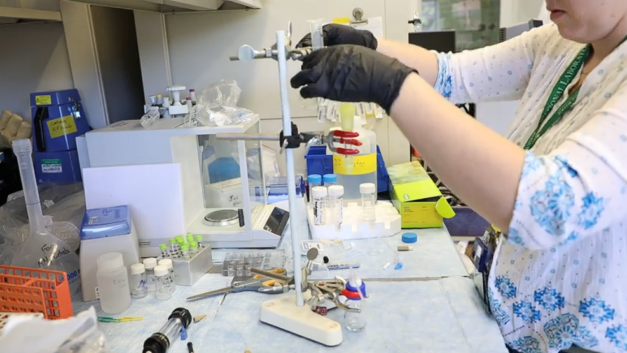
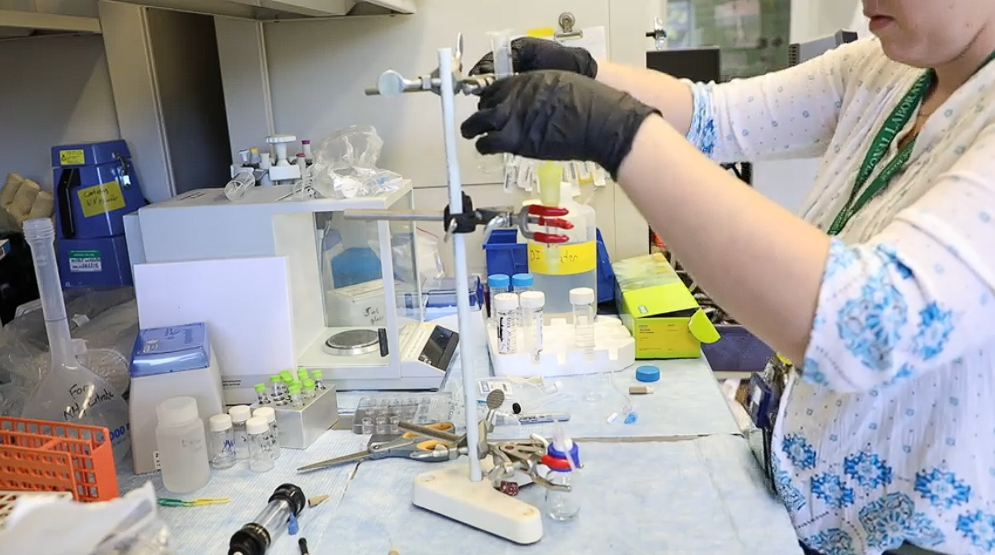
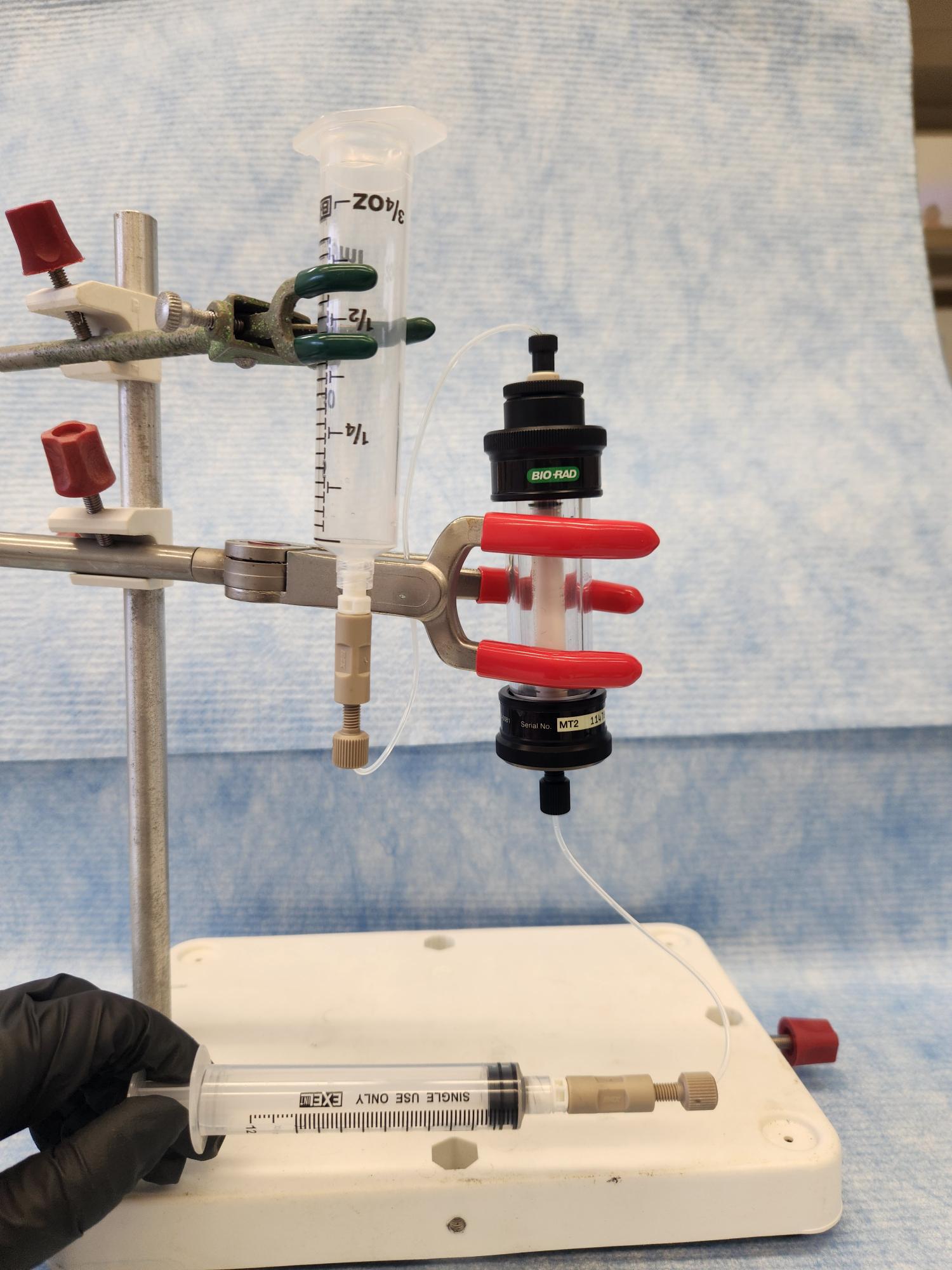
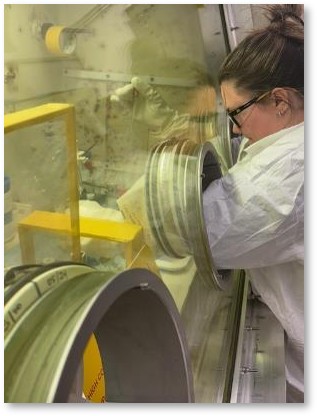
Building the generator is fairly straightforward. Basically, it’s a round column a few inches tall filled with a filtering material that captures W-188 but allows Re-188 to pass through to be eluted by the customer. Though it’s built in a glovebox or hot cell, depending on the dose, the finished generator can be used in a fume hood, making it more easily usable for researchers and clinicians outside a national lab.
“I always try to think about what the customer needs and what the customer’s goal is; most of the time that’s going to be either preclinical or clinical trials,” Hoerres said. “How do I make their lives as easy as possible so that they don’t have to think about all the chemistry and everything that goes into building their generator? They can just elute it, take the rhenium, and go and do great things with it.”
She’s made some tweaks to the design last used at ORNL. For example, the original generators used complicated, expensive components fabricated by the ORNL Glass Shop, which does incredible custom work, she said. The simplified design that replaced it is easier to connect and costs less.
Hoerres is also looking at how to safely scale up to building higher-activity generators. She believes ORNL will ramp up generator production for NIDC customers who find new uses for Re-188 or want to source their products in the U.S., avoiding potential issues with foreign suppliers.
“The demand for these generators has grown,” she said. “NIDC and DOE IRP recognize that and thought that maybe it was about time we brought the generators back.”
Broadening research possibilities
Vanderbilt’s Sabbineni and Carrasco were the first to use the updated generators, as tools for their own innovation.
For more than 75 years, thyroid cancer has been successfully treated with radioiodide therapy, with few side effects. NIS transports radioiodide into thyroid cancer cells, where it breaks their DNA bonds.
When Carrasco’s group cloned the DNA coding for NIS in 1996, they opened the door for using gene transfer to treat other cancers outside the thyroid, foundational science that continues to generate new applications decades later.
Sabbineni’s research builds on that and on Llorente-Estenban’s engineering of an NIS protein that transports perrhenate containing Re-188 but does not transport iodide. Using nanoparticles called polyplexes, Sabbineni is targeting prostate tumors with the engineered NIS protein and perrhenate containing Re-188, a beta-emitting isotope with the potential to penetrate deep into tissue. Its short half-life minimizes potential damage to surrounding healthy cells.
A little more than a year from the time Sabbineni and Carrasco reached out to ORNL, they received the improved Re-188 generator. Kevin Fu of Vanderbilt’s Radiation Lab helped them elute the Re-188 by following instructions Hoerres gave him over a Zoom call.
In the meantime, Sabbineni was growing prostate tumors in mice in her lab at Vanderbilt. Once the tumors grew, the mice received polyplexes containing the engineered NIS molecule as well as perrhenate containing Re-188.
Injected intravenously, perrhenate containing Re-188 appears to destroy the tumors, and the treatment does not appear to have negative effects on other parts of the body, even when administered systemically and allowed to travel throughout the body.
The preliminary research was positive.
“It was effective,” Sabbineni said. “Right now, the results look promising. We’re very excited.”
The generator, housed in a radiation safety lab at Vanderbilt, should last long enough for more research to further test their findings. If they’re successful, more Re-188 generators ultimately will be needed for clinical trials — and for more research into treating other types of cancers.
“I think it’s important to let people know that ORNL is on track to start building and distributing these generators,” Hoerres said. “It’s on the NIDC’s website as ‘coming soon,’ which is exciting.”
She’s excited for radiopharmaceutical researchers at ORNL to innovate more potential applications for Re-188, now that it’s more available.
“It’s a versatile isotope, and I think it will do some great things in the clinic,” Hoerres said. “Here at ORNL, we have the production side, the generator fabrication side, and then we could also show what you can do with it. That would be the ultimate goal.”
UT-Battelle manages ORNL for the Department of Energy’s Office of Science, the single largest supporter of basic research in the physical sciences in the United States. The Office of Science is working to address some of the most pressing challenges of our time. For more information, please visit energy.gov/science. — Kristi L. Bumpus
Related Researchers