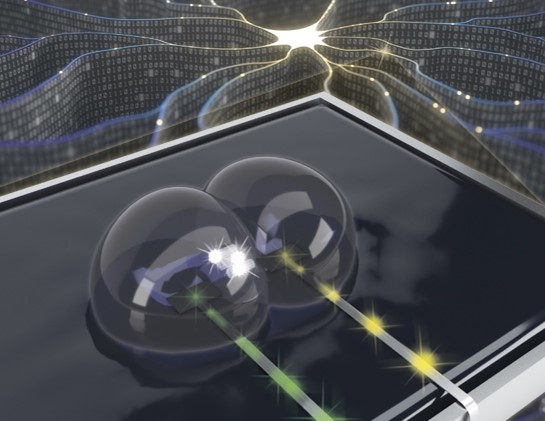
Scientific Achievement
Synthetic biomembranes doped with voltage-activated alamethicin peptides yield low-power, two-terminal devices with structure and switching mechanism resembling biological synapses.
Significance and Impact
The development of biomembrane-based devices based on stimuli-responsive biomolecules is a major step toward full implementation of synaptic functionalities in neuromorphic hardware, leading to highly efficient, high-density computing systems.
Research Details
– Lipid bilayer membranes containing voltage-gated ion channels were assembled between aqueous droplets suspended from wire electrodes in an oil-filled reservoir.
– Current-voltage measurements were made using cyclic voltammetry with different sweep rates, and mathematically fit to physical models of biomolecular memristors.
J. S. Najem, G. J. Taylor, R. J. Weiss, Md. S. Hasan, G. Rose, C. D. Schuman, A. Belianinov, C. P Collier, and S. A. Sarles, “Memristive ion channel-doped biomembranes as synaptic mimics,” ACS Nano 12, 4702 (2018). DOI: 10.1021/acsnano.8b01282
Related Researchers