Conventional tamper-evident adhesive seals can be vulnerable to duplication or manipulation because verification often relies on visual inspection and printed identifiers. This technology enhances adhesive tamper-indicating seals with a passive embedded electronic feature that provides a measurable signature unique to each seal. Attempts to physically or thermally tamper with the seal can alter that signature,
Using sensors mounted on the robot or calibrated within the robot coordinate frame, a point cloud is generated. Depending on the sensors used and number of scans needed to fully capture the part and workspace, multiple point clouds may need to be combined and/or filtered. The part of interest is segmented from the remainder of
Electronic Navigational Charts (ENCs) are essential for safe maritime navigation but evaluating whether chart updates present critical safety risks often requires time-intensive expert review. This technology uses artificial intelligence to automate the classification of ENC changes, helping organizations rapidly distinguish between critical and non-critical updates. By reducing manual review efforts and improving the efficiency of
AI-powered software development tools can reduce the time and expertise required to build interactive applications for complex scientific data. This technology provides an autonomous development pipeline that helps domain experts transform software concepts into functional visual interfaces, accelerating application development while reducing manual coding. The approach streamlines the creation of web-based dashboards for scientific visualization
Advanced nuclear fuel systems often rely on uniform fuel architectures that limit flexibility in addressing localized operating conditions within a reactor. This technology enables the fabrication of fuel compacts or pebbles with tailored internal particle distributions, allowing different functional particle types to be strategically incorporated within a single fuel body. The approach supports improved reactor
This technology introduces a new approach for the generation of continuous variable cluster states for measurement-based quantum computing in a compact and scalable optical system. It leverages a different degree of freedom to reduce the required quantum resources needed for scalability by using independently addressable spatial modes to multiplex sources of entangled light into a
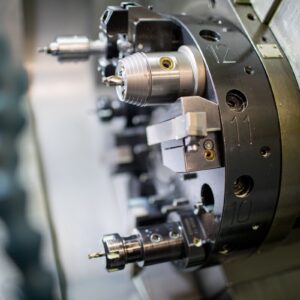
Servomotor-controlled adjustments provide a method to improve the alignment process of machine tool frames by replacing manual adjustments traditionally performed by operators. Current alignment procedures can be time-consuming and limited by the precision and accessibility available to human operators. The proposed approach integrates automated actuation to adjust frame leveling elements, reducing the time required for
MAPSTER Nomad (Multi-Platform Automated Processing, Storage, Tasking, Exploitation, and Retrieval) is a geospatial data sharing software platform developed by Oak Ridge National Laboratory that enables rapid collection, processing, and dissemination of geospatial data from distributed sensors and unmanned systems. The technology automates the ingestion and organization of imagery, video, and 3D geospatial products and makes
This technology enhances the Cyber Grid Guard framework to improve monitoring and verification of commands and device activity across operational networks. The system processes network packet traffic and device-generated data to verify whether commands originate from legitimate sources and produce expected device behavior. By organizing network activity, device records, and anomaly indicators into structured data
LuGo is a software-based advancement that improves the efficiency of a widely used quantum computing algorithm– quantum phase estimation– by significantly reducing the time and resources required to generate quantum circuits. The technology addresses a major bottleneck in existing implementations that limits scalability as problem sizes grow. By restructuring how certain circuit components are generated,
Plasma-facing components are subject to severe surface deterioration, degradation, and restructuring that limits performance, reliability, quality and service life in plasma-generating/ exposed systems and affects plasma quality and stability. This technology addresses erosion and damage caused by prolonged plasma exposure using plasma-resistant coatings designed to protect plasma generating electrodes and plasma-facing materials. By mitigating multiple
SCARS-Q introduces an advanced approach to vibrational imaging that enhances signal sensitivity while reducing background noise. By employing quantum-seeded light fields, this technology improves efficiency and detection performance for weaker molecular signals. The innovation strengthens advanced Raman-based systems without requiring major design changes, paving the way for more precise spectroscopic tools across biomedical and materials