The Department of Energy’s (DOE) Oak Ridge National Laboratory (ORNL) has been selected for six Phase II awards under the DOE’s Genesis Mission. The six multi-year projects will advance Super Intelligence (SI)-enabled research in materials science, microelectronics, quantum computing, accelerator operations, HPC software development and fusion energy, building on work initiated during Genesis Mission Phase
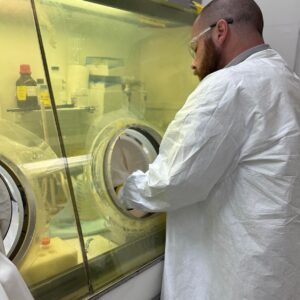
ORNL researchers are improving methods to recover tiny amounts of rare radioisotopes produced during californium-252 production. The more efficient processes increase purity and recovery while reducing workers’ radiation exposure, providing materials for research on the heaviest elements.
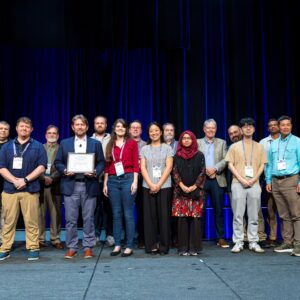
ORNL received the IEEE Quantum Technical Community Distinguished Synergy Award for its collaborative approach to advancing quantum materials, computing, networking and sensing. The award recognizes ORNL’s work bringing together expertise, research facilities and partners to move quantum technologies from scientific discovery toward practical applications.
Quantum materials are the foundation for ORNL’s quantum technology innovations. Quantum computing, networks, and sensors all require the discovery, design, understanding, and synthesis of materials that display unique quantum phenomena like superposition, entanglement, or superconductivity. But quantum materials are also the product of quantum technology: The discovery and understanding of new materials are, in turn,
ORNL earned a new lab record with 22 R&D 100 Awards in 2026 for technologies that advance energy, manufacturing, computing, biotechnology and other fields. ORNL led 18 of the winning technologies and contributed to four additional award-winning projects led by partner institutions.
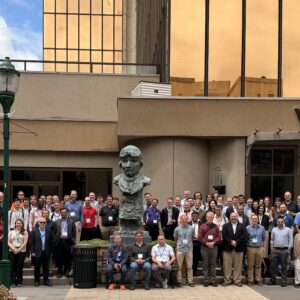
ORNL convened scientists, engineers and technology leaders for the 2026 Southeastern Quantum Conference (SQC), bringing together experts from academia, national laboratories, industry and government to advance quantum information science and strengthen collaborations that support U.S. competitiveness.
John Lajoie, a physicist at ORNL, develops advanced particle detectors that help scientists study the fundamental structure of matter while often enabling innovations in other scientific fields. As spokesperson for the ePIC Collaboration, he is helping design the detector for the future Electron-Ion Collider, which will use cutting-edge detector technology, streaming data, and AI to explore how quarks and gluons shape protons, neutrons, and nuclear matter.
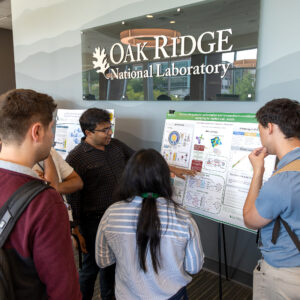
ORNL’s seventh annual Quantum Computing User Forum brought together 184 researchers, developers and industry leaders to showcase advances in quantum applications, software, and hybrid quantum-HPC computing enabled through QCUP. The event also strengthened collaborations across the quantum community and highlighted ORNL’s role in developing the technologies, software ecosystem and workforce needed to make quantum computing a practical tool for scientific discovery.
The Department of Energy’s Oak Ridge National Laboratory scientists will lead nine and contribute to an additional 30 projects of the Genesis Mission, which aims to transform science in the U.S.
The Department of Energy’s Office of Isotope R&D and Production, within the Office of Science, today announced a major, multi-laboratory breakthrough in domestic stable isotope enrichment and production capabilities. Through a collaborative effort between Oak Ridge National Laboratory and Pacific Northwest National Laboratory, the U.S. has developed pioneering technologies to produce ultra-enriched silane and germane that are extremely depleted in noise-inducing contaminant isotopes.
ORNL signed a memorandum of understanding with Chattanooga entrepreneur center The Company Lab designed to facilitate the deployment of ORNL technology and strengthen the region's growing deep-tech ecosystem.
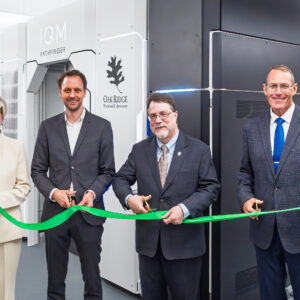
ORNL has deployed Pathfinder, a new 20-qubit IQM Radiance quantum computer, to advance research that combines quantum computing with high-performance computing. The system will help researchers develop open, hardware-agnostic quantum-HPC software and explore applications in materials science, chemistry, and artificial intelligence.