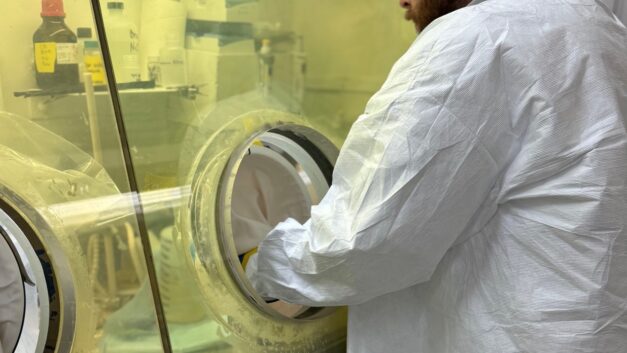
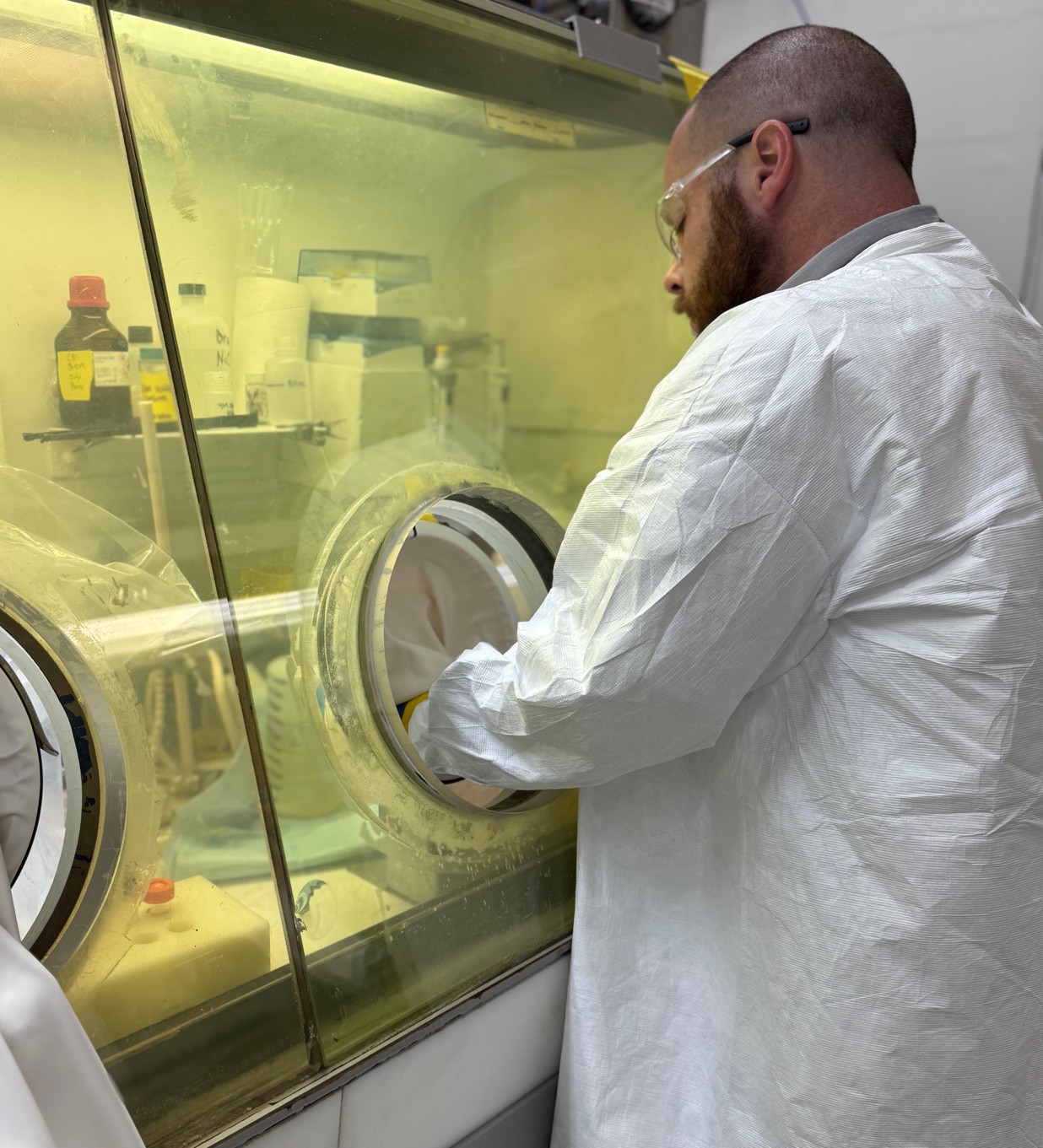
The Department of Energy’s (DOE) Oak Ridge National Laboratory (ORNL) is the Western world’s only source for the neutron-emitting radioisotope californium-252 (Cf-252), which an industrial consortium uses to make sealed sources used for nuclear reactors startups, among other applications. The Cf-252 production work is coordinated and funded by the DOE’s Office of Isotope R&D and Production (IRP), within the Office of Science.
But these crucial Cf-252 production campaigns also yield very small amounts of radioisotopes that are highly sought after for research: isotopes of einsteinium (Es-253/254), berkelium (Bk-249) and fermium (Fm-257).
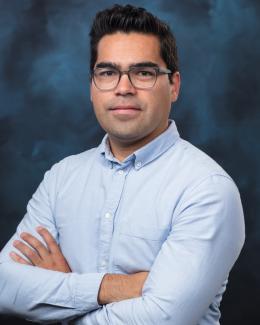
These “tiny, tiny amounts” make up the whole stock available for purchase every two years, said Cristian Celis-Barros, an R&D radiochemist in ORNL’s Isotope Science and Enrichment Directorate who serves as principal investigator and subject matter expert for the recovery of these radioisotopes, which would otherwise be waste.
Through a project separate from the Cf-252 program, but also funded by DOE IRP, Celis-Barros has worked on improving the process of purifying these “byproduct” radioisotopes for customers who claim them before they’re even produced, primarily through DOE’s Office of Science’s Basic Energy Sciences Heavy Element Chemistry Program.
The Cf-252 campaign produces milligrams of berkelium-249; micrograms of einsteinium-253/254; and picograms of fermium-257. To help visualize that, if a milligram is the weight of a single grain of sand, then a microgram is a microscopic speck of dust, and a picogram is the weight of a single cell’s DNA.
These rare radioisotopes allow scientists to study the heaviest elements on the periodic table — and discover new elements. ORNL-produced berkelium-249 was famously used in the discovery of superheavy element 117, tennessine. ORNL-produced radioisotopes were also used in the discoveries and confirmations of superheavy elements 114, flerovium; 115, moscovium; 116, livermorium; and 118, oganesson.
Celis-Barros is building on separation processes developed about five years ago by ORNL’s Miting Du, who retired in 2025. Du’s work replaced processes that were developed in the 1950s and were still in use. Celis-Barros said the processing of berkelium has changed very little from campaigns using Du’s methods — except for adding a new step with very visible results.
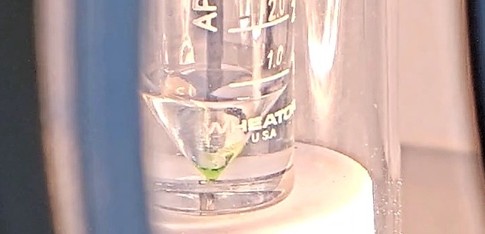
Putting the berkelium through an extra column run that retains the Bk-249 and lets other impurities through, with the aim of increasing chemical purity in addition to radiochemical purity, transformed the muddled yellowish solution to a pure solid crystalline green: visual evidence of its purity.
“You don’t have to be a chemist to realize that one is pretty and the other is not,” Celis-Barros said, laughing.
Celis-Barros was inspired to add the step after his work with another radioisotope produced at ORNL: promethium-147. The chemical purification had yielded good results in that process, he said.
“I was reluctant to modify the Bk process because it was working so great,” he said, “but it was a given to try it.”
Celis-Barros cautioned that the process is preliminary and still being established, but he is optimistic about its future at ORNL.
He used the same type of column for Es-253/254 separation used for Bk-249, but optimized conditions to maximize Es’s separation from Cf-252. By the campaign’s end, 95 percent of the Es-253/254 was recovered per column run — significantly more than in past campaigns.
“That was pretty satisfying to see at the end of the campaign,” he said.
That success will give the team a head start for the next campaign, in 2027, and allow them to be more efficient when removing unwanted material and then analytically separating Cf-252 out of the Es-253/254 product.
Recovering these research radioisotopes is challenging. Besides their tiny amounts, they must be pulled from a solution that usually still contains micrograms of highly radioactive Cf-252. Because the work is done in gloveboxes, rather than in the more costly shielded hot cells where the bulk of Cf-252 is separated out, researchers must be careful to work quickly, lest they receive their maximum allowable dose of radiation before they’re finished.
For the most recent campaign, Celis-Barros used a different column with the goal of separating Es-253/254 from Fm-257 to ultimately get Fm-257 to DOE’s IRP, which could offer it to researchers. For this separation, he changed the column through which the solution passes from the resin typically used, DGA, to a different resin, with good results.
“In previous campaigns, there was no interest for separating Es-253/254 and Fm-257 from each other,” Celis-Barros said. “Now there is an interest in getting those radioisotopes separated. What we’re doing is nothing that hasn’t been done. We’re just trying to simplify and come up with processes that are more efficient and expose workers to less radiation.”
He knew it was successful by what he couldn’t see.
“For the amount we’re producing, you shouldn’t be able to see anything with your naked eye,” he said. “That’s how pure this is. That’s what we were able to accomplish: the chemical purity was close to 99.93 percent. We were pretty proud of that.”
Celis-Barros compares optimizing the processing to “cracking the code,” and he credits the help of scientists in analytical labs, technicians who are “rock stars,” and many others.
“The effort of multiple people and groups for these tiny amounts, picogram-scale, microgram-scale, is just awesome,” he said. “It takes a coordinated effort to make this happen.”
During the upcoming Cf-252 campaign, they’ll try to improve it further.
“We’re hoping to be even more efficient and recover more than we did, because we know now how to make it happen and how to prepare for it,” he said.
Recovering fermium is a challenge because so little is known about the element and its radioisotopes. Decades ago, ORNL researchers quantified fermium, which was discovered in 1952, but there was lack of interest in the scientific community at that time.
Now renewed interest has driven research institutions’ desire for fermium.
“Physicists are interested,” Celis-Barros said. “They need atoms to do experiments. If we learn more about fermium, we can potentially expand to the point where DOE is supportive of making more of these radioisotopes. The demand is there. People want to study these elusive elements.”
Fermium’s potential applications are unknown. Its radioisotopes could have uses in medicine or industry.
“That’s why we do this chemistry,” Celis-Barros said. “When Glenn T. Seaborg advocated for ORNL’s High Flux Isotope Reactor neutron source and a specialized for processing transuranic elements, it was to make more of these heavier elements and study their isotopes.”
ORNL is “definitely pushing the boundaries of chemistry,” he said. “Not even all the textbooks are updated with all the stuff we can do. It’s pretty entertaining and exciting.”
For Celis-Barros, who began his career studying colorful beta-emitter berkelium in Chile from a theoretical perspective, this is a full-circle moment. As a postdoctoral researcher under Thomas Albrecht at Florida State University, he was trained to use both berkelium and einsteinium safely and encouraged to spend time with them in the lab. Now, he’s pleased to be able to offer such a quality product to other researchers.
“It definitely has a place in my heart, and I’m super proud of helping others get access to it,” he said. “The goal is to give them the cleanest product we can get.
“This is my contribution — my little grain of sand — in the grand scheme of things.”
Read more about how ORNL is increasing californium-252 production to meet growing demand.
UT-Battelle manages ORNL for DOE’s Office of Science, the single largest supporter of basic research in the physical sciences in the United States. The Office of Science is working to address some of the most pressing challenges of our time. For more information, please visit energy.gov/science.
