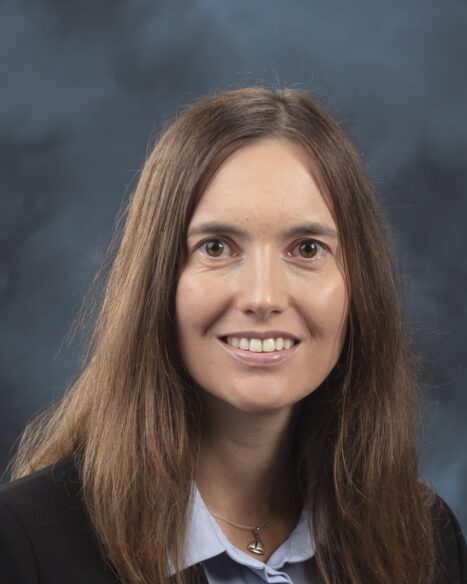
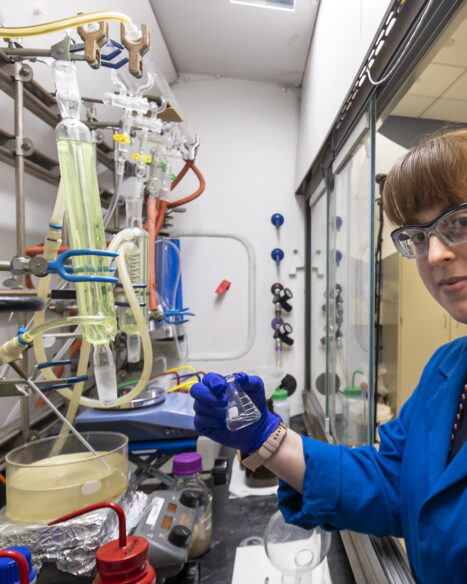
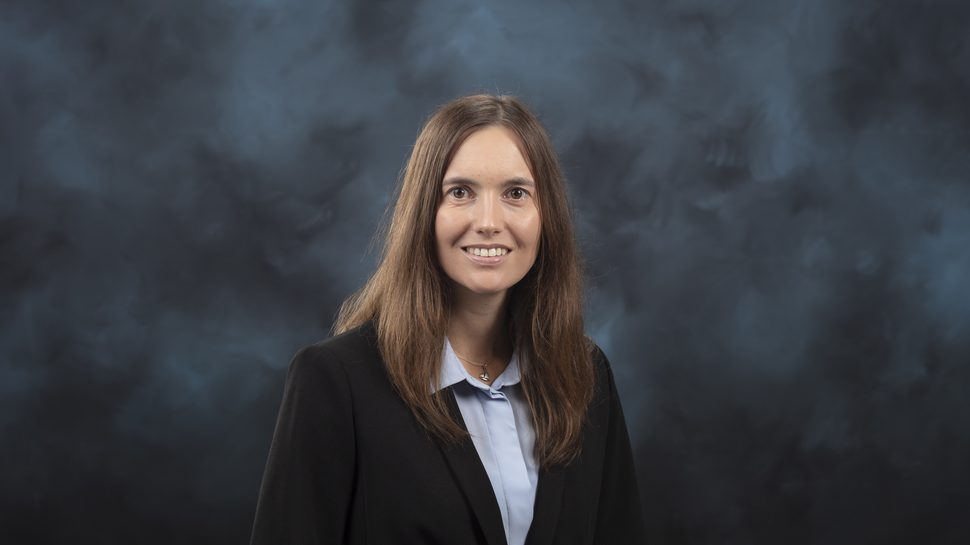
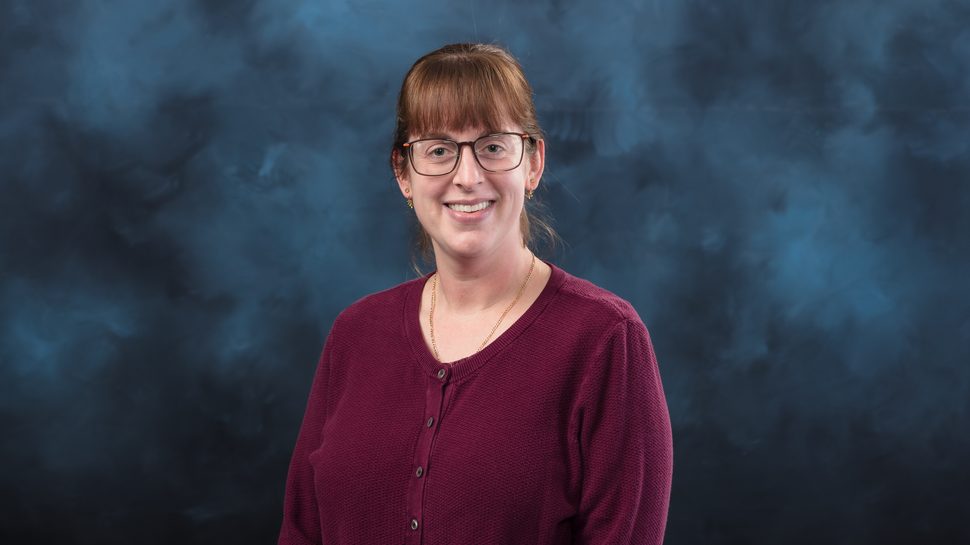
Sabine Neumayer, an R&D staff scientist at the Center for Nanophase Materials Sciences at the Department of Energy’s (DOE) Oak Ridge National Laboratory (ORNL), and Nikki Thiele, a staff scientist in ORNL’s Chemical Sciences Division, have been recognized with DOE Office of Science Early Career Research awards for innovative research.
Neumayer was selected by the DOE Basic Energy Sciences program for her proposal, “Ultrabroadband Microscopy of Multiscale Charge Dynamics in Interface-Tunable Neuromorphic Heterostructures.” The work in materials science advances understanding of fundamental science and supports emerging technologies.
Understanding how different types of charge interact across material interfaces is key to developing faster, more energy-efficient computing technologies. This project will develop ultrabroadband microscopy capable of capturing material behavior ranging from slow processes to ultrafast responses, enabling studies of nanoscale interactions among ionic, polar and electronic charges at interfaces between two-dimensional materials and ferroelectrics. The research will provide a foundation for controlling and predicting how these charges interact in material systems designed for neuromorphic computing.
Thiele pioneers new chelation strategies to advance the development of medical radionuclides, which are isotopes having unstable nuclei and extra energy. She was selected by the DOE Office of Isotope R&D and Production for her proposal, “Carcerand Encapsulation as a New Paradigm for Chelating Emerging DOE Medical Radionuclides.” A carcerand is a hollow host molecule that traps a smaller guest molecule or ion inside its interior cavity. The root of the word comes from the Latin for prison, carcer.
The goal of Thiele’s proposal is to understand how to design carcerands to permanently trap medical radionuclide ions within their constrictive cavities. The instability of radionuclide–chelator complexes has long hindered the advancement of many emerging medical radionuclides. Some radionuclides emit positrons or gamma rays, which can be used to detect, image and diagnose cancer. Others emit alpha particles, beta particles or Auger electrons, which can be used to treat cancer. Thiele’s project may free medical radionuclides from the “valley of death” between production and implementation that keeps them from realizing their full clinical potential.
“Early career researchers bring fresh ideas and perspectives to some of the nation’s most important scientific challenges,” said ORNL Director Stephen Streiffer.
The Early Career Research Program promotes national scientific discovery through early career researchers in fields related to the Office of Science’s major program offices: Advanced Scientific Computing Research, Biological and Environmental Research, Basic Energy Sciences, Fusion Energy Sciences, High Energy Physics, Isotope R&D and Production, and Nuclear Physics. The awards recognize researchers within the first 10 years of their careers, highlighting emerging leaders in science.
Read more about the Early Career Awards from DOE.
UT-Battelle manages ORNL for the Department of Energy’s Office of Science, the single largest supporter of basic research in the physical sciences in the United States. The Office of Science is working to address some of the most pressing challenges of our time. For more information, please visit energy.gov/science. – Scott Gibson and Dawn Levy