
For the first time, researchers have synthesized lateral semiconductor heterojunctions in lithographically patterned arrays within a two-dimensional
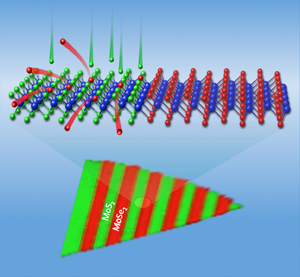
semiconductor crystal monolayer by a novel process that selectively converted exposed regions of a monolayer of MoSe2 to MoS2 using laser-deposited sulfur. The development of a scalable, easily implemented process to lithographically pattern and easily form lateral semiconducting heterojunctions within two-dimensional crystals fulfills a critical need for “building blocks” required to enable next-generation ultrathin devices for applications ranging from flexible consumer electronics to solar energy.
Regions of monolayer molybdenum diselenide crystals were covered by patterns of a protective layer of silicon dioxide that was applied using standard lithography techniques. The exposed regions were rapidly converted to molybdenum disulfide through the replacement of Se by S within the lattice, forming arrays with sharp (~5 nm) MoSe2/MoS2 junctions. This work establishes a scalable processing technique to form patterns of semiconductor heterojunctions to enable the next generation of two-dimensional electronic and optoelectronic devices.
Masoud Mahjouri-Samani, Ming-Wei Lin, Kai Wang, Andrew R. Lupini, Jaekwang Lee, Leonardo Basile, Abdelaziz Boulesbaa, Christopher M. Rouleau, Alexander A. Puretzky, Ilia N. Ivanov, Kai Xiao, Mina Yoon, and David B. Geohegan, “Patterned Arrays of Lateral Heterojunctions within Monolayer Two-Dimensional Semiconductors,” Nature Commun. 6, 7749 (2015). DOI: 10.1038/ncomms8749
Related Researchers