The Department of Energy’s (DOE) Oak Ridge National Laboratory (ORNL) is developing new chemical separation methods to recover gallium from domestic zinc refinery residues, potentially creating a new U.S. source of a critical material used in advanced semiconductors, electronics and energy technologies.
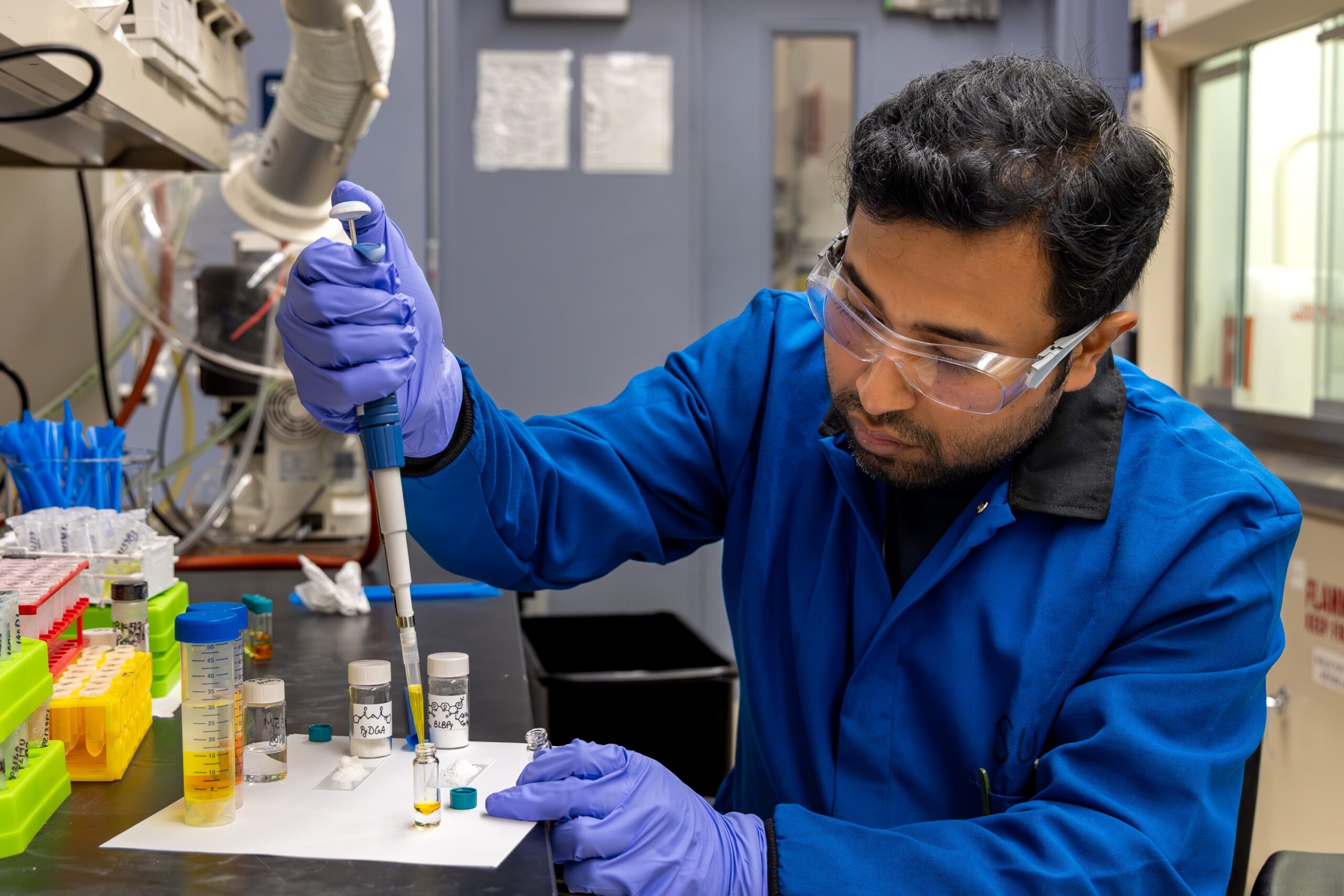
Led by ORNL researcher Subhamay Pramanik, the project combines computational modeling, molecular design and experimental chemistry to develop new chemical extractants and reusable engineered polymer resins designed to capture gallium from complex metal mixtures. Working with researchers at the University of Tennessee, Knoxville, the ORNL team aims to build selectivity into the chemistry itself, potentially reducing processing steps, chemical consumption and waste generation compared with conventional separation methods.
Recovering gallium as a byproduct of zinc processing is challenging because it occurs at very low concentrations alongside much higher levels of competing metals, making it difficult to isolate.
To address this challenge, the researchers will design molecules that preferentially bind to gallium and incorporate them into materials that capture the metal while leaving most other metals behind. Computational modeling will help identify promising molecular designs, which the team will then synthesize and test in the laboratory to determine how effectively they separate gallium from complex metal mixtures.

“The real promise of this approach is making gallium recovery from domestic industrial waste streams both technically feasible and economically viable,” Pramanik said. “If successful, our work could help turn an underutilized resource into a reliable domestic supply of a material essential to advanced U.S. technologies.”
The project draws on ORNL’s expertise in molecular design, chemical synthesis, computational modeling and advanced materials characterization. By combining these capabilities with resin engineering and critical-material separations research, the team aims to develop and validate a gallium recovery process that could eventually be adapted for industrial use.
Within 18 months, the researchers aim to demonstrate efficient and selective gallium recovery from actual industrial feedstocks, evaluate the resins’ reusability and long-term stability, and establish a laboratory-scale separation process with a clear pathway toward industrial scale-up.
The approximately $2.1 million project is funded by DOE’s Critical Materials Innovation (CMI) Hub and is scheduled to run for 18 months from January 2027 through June 2028.
Pramanik, a synthetic physical-organic chemist in the Nanomaterials Chemistry Group within ORNL’s Chemical Sciences Division, led the proposal, which advanced from an internal ORNL competition to external review and selection by the CMI Hub.
The team is designing the recovery process with potential integration into existing zinc-processing operations in mind. In addition to improving gallium recovery, the technology could enable the recovery of germanium, another critical mineral, while reducing processing costs, chemical consumption and waste.
By recovering valuable minerals from underutilized domestic mining and refinery byproducts, the approach could create new economic opportunities, reduce reliance on imports and strengthen U.S. critical-materials supply chains.
The research builds on ORNL’s expertise in developing innovative extraction and separation technologies and advancing materials and chemical processes from fundamental discovery toward practical industrial applications.
UT-Battelle manages ORNL for DOE’s Office of Science, the single largest supporter of basic research in the physical sciences in the United States. The Office of Science is working to address some of the most pressing challenges of our time. For more information, please visit energy.gov/science.