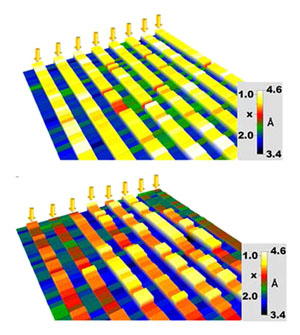
Atomic-scale maps of oxygen distribution in La0.5Sr0.5CoO3-d films reveal that the overall composition and the degree of oxygen order varies drastically between films of the same cation composition but grown on different substrates (top: on orthorhombic NdGaO3, bottom: on cubic [La, Sr][Al,Ta]O3). The maps show the structure as comprised of alternating stoichiometric CoO2 and oxygen depleted CoOx layers (arrowed); layer spacing depends linearly on its oxygen content x.
Electron-microscopy based local lattice parameter measurements yield a direct map of oxygen vacancy concentrations in a complex oxide, extending the concept of chemical expansivity to a sub-unit cell level.1 Local oxygen stoichiometry in functional oxides has been a long-standing challenge that needs to be addressed in order to elucidate the physics of strongly correlated oxides and improve materials performance for applications ranging from fuel cells and sensors to memristive data storage. The method developed in this work quantifies oxygen vacancy distribution and homogeneity, which directly control the operation of solid-oxide fuel cells and are intrinsically coupled with magnetic, electronic, and transport properties of oxides. This new approach is successfully applied to lanthanum strontium cobaltite thin films epitaxially grown on substrates of different symmetry, where polarized neutron reflectometry reveals strong differences in magnetic properties. The different vacancy content found in the two films (see figure) suggests a change in oxygen chemical potential resulting from substrate-induced strain asymmetry that leads to distinct magnetic properties. This opens a new pathway for structural tuning of oxygen stoichiometry and resulting functional properties.
For more information, please contact Albina Borisevich,[email protected].