
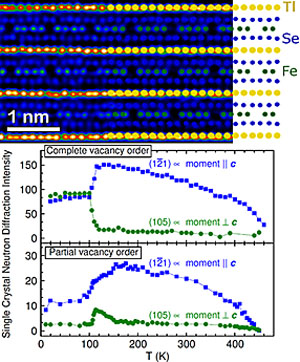
The examination of the first homogeneous crystals of an intercalated iron selenide revealed that the physical properties in
homogeneous iron selenide crystals are the result of coupling between ordered and disordered regions. Understanding the interactions between structure and properties is a primary goal in the search for high-temperature superconductors, and can be nearly impossible to achieve without studying homogeneous single crystals. For the recently discovered superconductors
Fe
Se
(
=K,Cs,Rb,Tl), all known superconducting samples are composed of multiple phases that contain different degrees of order. By demonstrating that the magnetic behavior of homogeneous TlFe
Se
(complete vacancy order) is different from that of inhomogeneous TlFe
Se
(partial vacancy order) it was shown that a strong coupling of local regions dictates the properties of multi-phase samples (see lower panel). This observation that superconductivity in
Fe
Se
may be stabilized by an interaction between a magnetic phase and the superconducting phase was made possible through a combination of specialized electron microscopy, crystal growth, and neutron diffraction, and is essential to understanding the influences of phase separation in superconducting
Fe
Se
materials.
A. F. May, M. A. McGuire, H. Cao, I. Sergueev, C. Cantoni, B. C. Chakoumakos, D. S. Parker, B. C. Sales, “Spin reorientation in TlFe1.6Se2 with complete vacancy ordering,” Phys. Rev. Lett., 109 077003 (2012). DOI:10.1103/PhysRevLett.109.077003
For more information contact: