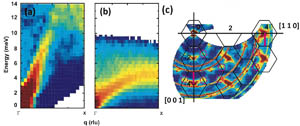
A spontaneously forming nanostructure is identified as the origin of the extremely low glass-like thermal conductivity of AgSbTe
. Control and manipulation of heat flow are central to many energy technologies from building insulation and engine cylinder walls, where low thermal conductivity is desired, to heat exchangers and nuclear reactor fuel pellets, where very high heat conduction is required. AgSbTe
has long been known to have an extremely low thermal conductivity, even in crystalline form (it is a factor of two better at insulating heat than amorphous SiO
), which enables high-performance thermoelectric modules that can be used for recovery of waste heat. This combined neutron scattering and microscopy work shows that naturally forming domains with different ordering of the cation sublattice lead to a suppression of thermal conductivity to a glass-like level. The results, which provide a general approach to controlling heat flow, were made possible by a broad collaboration within Oak Ridge National Laboratory, highlighting capabilities in materials synthesis and inelastic neutron scattering measurements. Electron microscopy work was performed at MIT.
For more information, please contact Olivier Delaire, [email protected].
J. Ma, O. Delaire, A. F. May, C. E. Carlton, M. A. McGuire, L. H. VanBebber, D. L. Abernathy, G. Ehlers, T. Hong, A. Huq, W. Tian, V. M. Keppens, Y. Shao-Horn, and B. C. Sales, “Glass-like phonon scattering from spontaneous nanostructure in AgSbTe2,” Nature Nanotechnology (2013). DOI: 10.1038/NNANO.2013.95