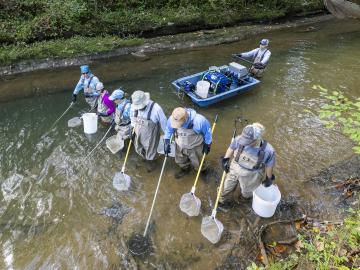
ORNL’s Biological Monitoring and Abatement Program, or BMAP, is marking 40 years of helping steward the DOE’s 33,476 acres of land on which some of the nation’s most powerful science and technology missions are carried out.


ORNL’s Biological Monitoring and Abatement Program, or BMAP, is marking 40 years of helping steward the DOE’s 33,476 acres of land on which some of the nation’s most powerful science and technology missions are carried out.

Phong Le is a computational hydrologist at ORNL who is putting his skills in hydrology, numerical modeling, machine learning and high-performance computing to work quantifying water-related risks for humans and the environment.
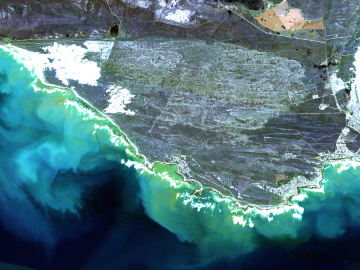
Scientists and land managers interested in accessing the first dataset of its kind on one of the most biologically diverse ecosystems in the world were given hands-on tutorials during a recent workshop by researchers supporting the ORNL Distributed Acti

The ForWarn visualization tool was co-developed by ORNL with the U.S. Forest Service. The tool captures and analyzes satellite imagery to track impacts such as storms, wildfire and pests on forests across the nation.

Researchers have identified a molecule essential for the microbial conversion of inorganic mercury into the neurotoxin methylmercury, moving closer to blocking the dangerous pollutant before it forms.

The Environmental Sciences Division at the Department of Energy’s Oak Ridge National Laboratory recently conferred the organization’s 2024 Distinguished Achievement Awards on November 11, honoring both scientists and support staff.
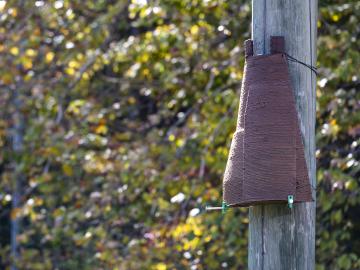
Oak Ridge National Laboratory researchers are using a new bioderived material to 3D print custom roosting structures for endangered bats.
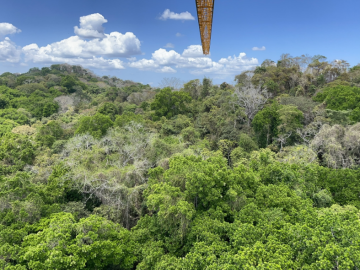
Plants the world over are absorbing about 31% more carbon dioxide than previously thought.

A new Global Biomass Resource Assessment developed by ORNL scientists gathered data from 55 countries resulting in a first-of-its kind compilation of current and future sustainable biomass supply estimates around the world.

Researchers led by Oak Ridge National Laboratory have been criss-crossing the Alaskan tundra for 12 years, collecting data as part of the Next-Generation Ecosystem Experiments in the Arctic project, or NGEE Arctic. They’re tracking rapid changes in the land as temperatures rise.