The Chemistry Support Laboratory (CSL) is a 1,000-square-foot workspace dedicated to R&D work on detectors, accelerator targetry, and non-rad chemistry support for the Physics Division’s experimental nuclear and high-energy physics programs.
Organic Scintillators
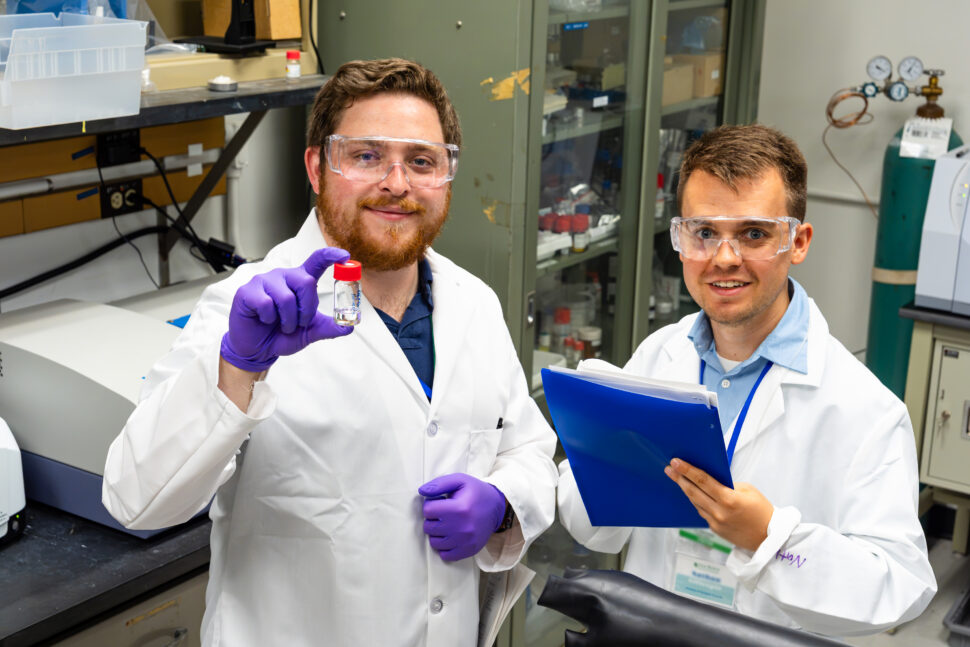
The CSL provides a unique capability to produce liquid, plastic, and crystalline organic scintillators using natural or enriched isotopes. Some of the scintillator capabilities include boron or lithium loading, PSD plastics, high-strength polyesters, multilayer phoswich designs, and enriched deuterium liquid and PSD plastic scintillators. Scintillators can be prepared in a wide range of geometries using a variety of fabrication techniques including bulk polymerization in casting molds, injection molding, and solvent cast films. The CSL houses a unique centrifugal polymerization apparatus which allows for preparation of monolithic or layered cylindrical geometries.
Synthesis Capabilities
A full suite of purification and organic synthesis apparati is available for synthesis of organic compounds and polymers. Some examples include synthesis of polyesters by transesterification / polycondensation, synthesis of trans-stilbene via Grubbs catalyst, and synthesis of isotopically enriched, highly branched compounds by Friedel-Crafts alkylation.
Material Characterization
A set of spectrophotometers, fluorometers, melting point, viscosity, and pH/Conductivity/ISE equipment is available for analysis of scintillators and materials. The CSL houses a Shimadzu single-quadrupole QP2010 SE gas chromatograph mass spectrometer (GC-MS) for analysis of organic compounds and gases.
Accelerator Targetry
The CSL houses a thin film thermo evaporator for preparation of isotopically enriched accelerator targets for nuclear physics experiments. The CSL also specializes in preparation of deuterated polyethylene targets.
3D Printing
Two Ultimaker 2 extended+ FDM 3D printers are available with a build volume 223 x 223 x 305 mm and a laser based FormLab 2 SLA 3D printer with a build volume 145 x 145 x 175 mm.