Capability Summary
Oak Ridge National Laboratory’s Creep Laboratory combines world-class instrumentation and analysis with deep materials expertise to drive the examination of structure-property relationships of metals, ceramics, and refractory alloys under extreme environments.
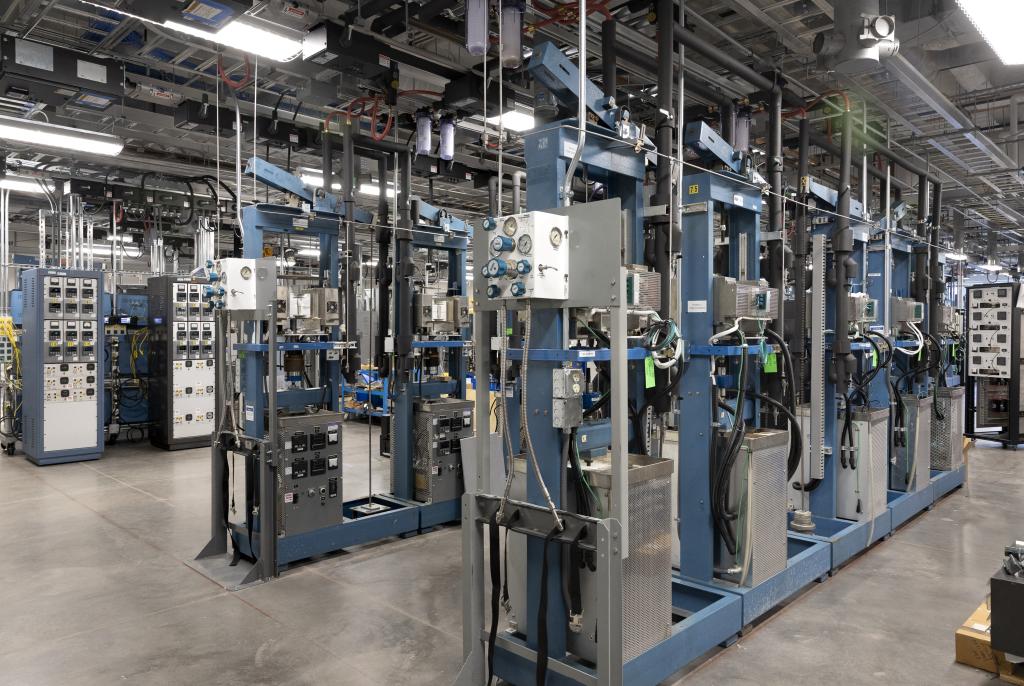
Through these assets, the Creep Laboratory offers an unparalleled dynamic range in temperature, force, strain rate, pressure, length scale, and time, spanning one to 15 orders of magnitude. It operates and maintains more than 200 precision engineered test frames designed to elucidate the fundamental mechanisms of time-dependent plastic deformation in the most intense and hostile environments imaginable. Housed in ORNL’s newly constructed Translational Research Capability building, the facility provides precise control of both the ambient temperature and relative humidity.
Data from macroscopic creep experiments are only the beginning, however. ORNL researchers excel at coupling experimental data across a wide range of length scales with quantitative microscopy and microstructural analysis to understand the atomic– to micro–scale mechanisms that govern deformation and failure. These insights guide the design and deployment of advanced structural materials for next-generation energy and defense systems.
Testing environments
- High vacuum
- Inert gases
- Corrosive atmospheres
- Molten Salt
- Liquid Metals
Contact
Dr. Erik Herbert is the Group Leader for Mechanical Properties & Mechanics at Oak Ridge National Laboratory, specializing in the mechanical behavior of materials. He holds a Ph.D. in Materials Science and Engineering from the University of Tennessee, Knoxville. Dr. Herbert has received multiple recognitions for his innovative research in structure-property-processing relationships and advanced mechanical testing. His work uses novel macro- and microscale mechanical testing techniques to elucidate how microstructure and defects control behavior across length scales, in controlled atmospheres, and at high homologous temperatures – leading to enhanced constitutive models, more accurate simulations, and accelerated materials design. Connect with Dr. Herbert at [email protected] to explore potential collaborations.