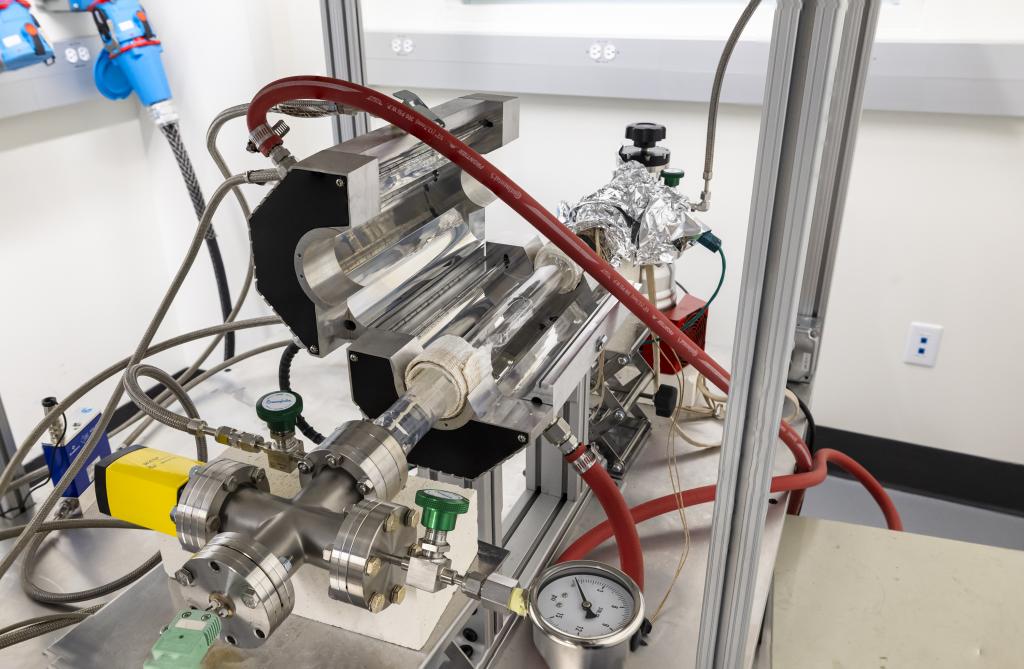
Capability Summary
Oak Ridge National Laboratory researchers are exploring material compatibilities in a wide range of pressure and temperature environments relevant to the public and private power generation, transportation and chemical processing sectors
Interactions with the environment are a critical consideration for materials research. ORNL has world-leading capabilities in understanding new and legacy materials’ compatibility with a broad range of environments including mixed gases (e.g., steam, air, carbon dioxide, sulfur dioxide, biogas, etc.), molten salts, liquid metals, and biofuels.
Using experiments that can run for tens of thousands of hours, researchers gather data on corrosion using characterization techniques ranging from microscopy to X-ray diffraction to atomic-scale techniques leveraging ORNL’s Center for Nanophase Materials Science and the Spallation Neutron Source. Access to ORNL’s high-fidelity material degradation modeling framework and computing resources deepens understanding of material performance and allows modeling exploration of dozens of material variations to lessen demands for lab experimentation. ORNL has decades of experience understanding corrosion and predicting component lifetimes in energy generation, vehicle engines and exhaust, and aerospace applications.
ORNL is supporting the recent resurgence of interest in beryllium salts among fusion and fission companies by applying its historical experience and cutting-edge scientific expertise to the challenge of beryllium. Multiple companies are pursuing molten salt fission reactor concepts and fusion energy concepts that utilize beryllium salts as a key component. ORNL’s experience with the Molten Salt Reactor Experiment in the 1960s positions it to support these exciting developments in energy generation.
Beryllium presents unique health and safety concerns, requiring specialized facilities to explore how it interacts with a variety of materials. ORNL has the capability to fabricate beryllium salts and conduct experimentation on them in special laboratories designed to safely work with the material.
Equipment & Facilities
Low-temperature corrosion test facilities including, but not limited to, brine-containing environments, aqueous solutions, CO2, H2S, and salt spray fog chambers
Controlled exposures in high-temperature mixed gas environments with multiple furnaces available to expose materials in a range of mixed gases (high-purity hydrogen, H2S, SO2, Cl2, CO/CO2, etc.) for temperatures up to 1400°C with precise control to regulate partial pressures of oxygen, nitrogen, sulphur, and carbon, etc.
High-temperature (up to 1500°C) and high-pressure (e.g., 800°C/300 bar) exposures in a range of environments (e.g., air, H2O, H2, H2S, CO2, SO2, biofuels, alkali sulphate salts, carbonate salts, nitrate salts, liquid metals, and molten halide salts)
Long-term isothermal aging and thermal cycling (tens and thousands of hours) in controlled, application-specific environments
Synthesis and purification of molten halide (fluoride and chloride) salts including beryllium containing salts
Dedicated glove boxes for safe handling, processing, and purifying hazardous liquid metals and molten salts
Established infrastructure and safety protocols for testing and handling beryllium salts
Contact
Dr. Rishi Pillai is the leader of the Corrosion Science and Technology group at ORNL, specializing in high-temperature corrosion and materials performance. He earned his Ph.D. in Materials Science from Aachen Technical University, Germany, in 2015. Dr. Pillai has received accolades for his research, including multiple awards for innovation in materials engineering. His work focuses on evaluating the high-temperature behavior of various alloys and developing predictive modeling methodologies for corrosion effects. For more information on collaborations, contact Dr. Pillai at [email protected].