Using High-Performance Mass Spectrometry to Characterize Biomolecules in Complex Biological Systems
Researchers in the Bioanalytical Mass Spectrometry Group at Oak Ridge National Laboratory specialize in the development and application of advanced mass spectrometry techniques to comprehensively characterize biomolecules within complex biological systems. Utilizing high-performance analytical instrumentation, the team addresses significant scientific challenges relevant to various research initiatives funded by the Department of Energy and the National Institutes of Health.
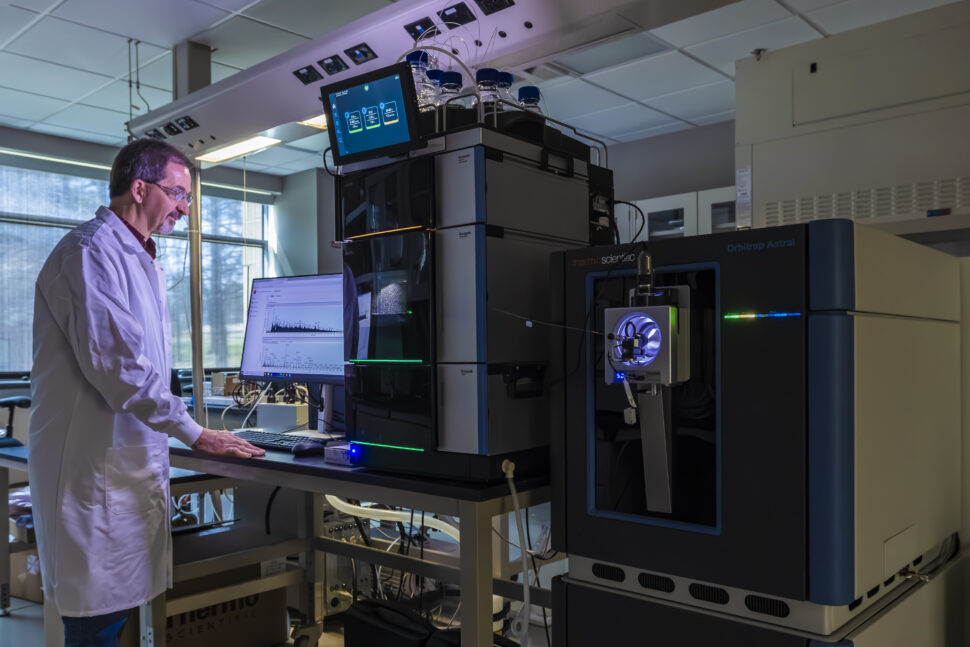
The group’s interdisciplinary research approach integrates technology innovation, specialized method development, and advanced informatics to thoroughly characterize biomolecules. The group places particular emphasis on the highly sensitive detection and precise characterization of proteins, lipids, and metabolites, providing critical insights into biological function and regulation.
Expertise is concentrated in two key areas:
Chemical imaging by mass spectrometry: This research area focuses on enhancing the sensitivity and spatial resolution capabilities of mass spectrometry-based chemical imaging. The aim is to precisely visualize and quantify small biomolecules, particularly metabolites, within biological samples. Scientists continually advance in-situ characterization methods within microfluidic devices and develop sensitive miniaturized probe sampling techniques, enabling detailed single-cell metabolomics and microscale biological analysis.
Liquid Chromatography Mass Spectrometry (LC/MS) for complex biological systems: Work in LC/MS involves extensive collaborative efforts with bioscientists to custom-design and implement sophisticated LC-MS/MS methodologies. These advanced analytical approaches allow researchers to perform comprehensive characterizations of proteomes, lipidomes, and metabolomes across diverse microbial and plant systems, including complex microbiome environments. The team executes integrated ‘omics measurement strategies to understand biological processes at a comprehensive, systems level.

The group maintains and operates a wide range of state-of-the-art mass spectrometric instrumentation, supported by advanced sample preparation facilities and dedicated instrumentation laboratories. Through ongoing method development and collaboration, researchers continue to advance biomolecular analysis, generating valuable data that deepens understanding of biological mechanisms and systems biology.
Researchers





Publications
Sep, 2026
Journal
Proteomics and characterization of lignocellulosic carbohydrate utilization for Thermoanaerobacterium thermosaccharolyticum reveals two thermophilic Gram-positive polysaccharide utilization loci
Saccharolytic bacteria are of increasing interest due to their importance in human health and the environment. In particular, their abilities to utilize diverse plant polysaccharides make them attractive candidate organisms for production of lignocellulosic biofuels. Thermoanaerobacterium thermosaccharolyticum is a thermophilic saccharolytic anaerobe able to utilize a vari…
Aug, 2026
Journal
Genome shuffling enables quantitative trait locus mapping in Bacillus subtilis
Genetic mapping is a powerful tool for eukaryotic genetics that has only been applied to bacteria in limited circumstances. Quantitative trait locus (QTL) mapping generally relies on sexual recombination to break linkages between genes, yet bacteria rarely undergo sufficient homologous recombination to generate suitable mapping populations. In this work, we used iterative…
Aug, 2026
Journal
Controlled Deuteration of Phosphatidylcholine Biosynthetically Produced from Engineered Escherichia coli for SANS Studies
Deuterated phosphatidylcholine (PC) was produced from engineered Escherichia coli (E. coli) BL21 cells grown in deuterated media. The levels of deuteration could be controlled by growing cells in different combinations of deuterated and nondeuterated water, glycerol, and choline, which were analyzed by NMR, mass spectrometric analysis, and small-angle neutron scattering (S…
Contact