Connecting Genes to Plant Characteristics for Improved Performance
Scientists in the Plant Systems Biology Group at Oak Ridge National Laboratory study the complex interactions between plant genes, environmental factors, and observable plant characteristics to enhance plant performance and productivity. The group seeks to identify and characterize the intricate networks of genes, proteins, metabolites, and environmental cues that collectively determine plant growth, resilience, and utility, particularly in the context of bioenergy and bioeconomy.

A significant portion of the work is focused on biodesign strategies aimed at improving bioenergy feedstocks. By leveraging genomic editing techniques and insights gained from systems biology, the research team engineers plant species to exhibit enhanced growth rates, increased resistance to environmental stressors, and optimized biomass production. Additionally, studies delve deeply into plant-microbe interactions, investigating how these relationships can be manipulated to promote nutrient uptake, disease resistance, and overall plant health.
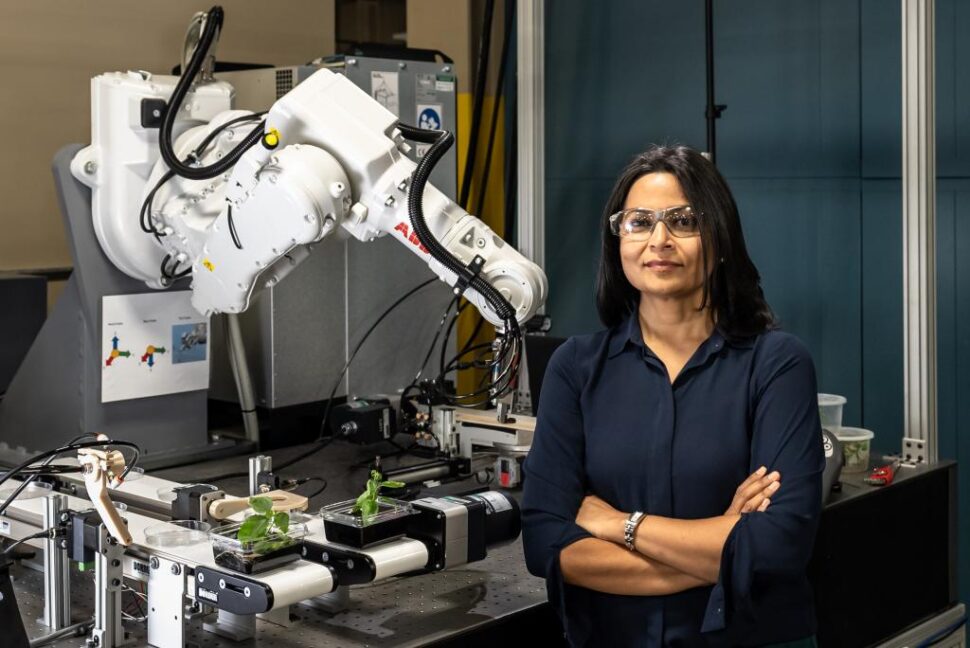
The group employs a wide array of advanced scientific methods, including molecular biology, genomics, neutron and radiochemistry-based imaging, and metabolomics as well as high-throughput phenotyping enabled by the Advanced Plant Phenotyping Laboratory at ORNL, a state-of-the-art imaging facility that leverages AI and automation to accelerate scientific discoveries that support abundant, secure, and affordable domestic energy for the nation. These tools enable researchers to quantify and visualize plant processes at unprecedented detail and scale, supporting the translation of fundamental biological discoveries into practical bioeconomy and ecological applications.
Current research collaborations includes initiatives with the Center for Bioenergy Innovation and the Plant-Microbe Interfaces Science Focus Area as well as projects supported by the DOE Office of Science Early Career program.
Researchers















Publications
Aug, 2026
Journal
Rethinking the soil core microbiome
The concept of a core microbiome emerged from host-associated research to describe microbial members or functions conserved across clearly defined spatial, temporal, and biological boundaries. In soil- and plant-associated microbiome research, however, the term has increasingly shifted toward analytically defined subsets selected using study-specific thresholds or criteria…
Aug, 2026
Journal
Genome shuffling enables quantitative trait locus mapping in Bacillus subtilis
Genetic mapping is a powerful tool for eukaryotic genetics that has only been applied to bacteria in limited circumstances. Quantitative trait locus (QTL) mapping generally relies on sexual recombination to break linkages between genes, yet bacteria rarely undergo sufficient homologous recombination to generate suitable mapping populations. In this work, we used iterative…
Jul, 2026
Journal
Single-cell and spatial omics in plants: from cellular atlases to regulatory mechanisms
Single-cell RNA sequencing (scRNA-seq) has transformed transcriptomic studies by enabling gene expression profiling at the resolution of individual cells within and across a broad range of tissue types, revealing cellular heterogeneity that is obscured in bulk tissue transcriptomes. Over the past decade, improvements in microfluidics and library preparation have drasticall…
Contact
