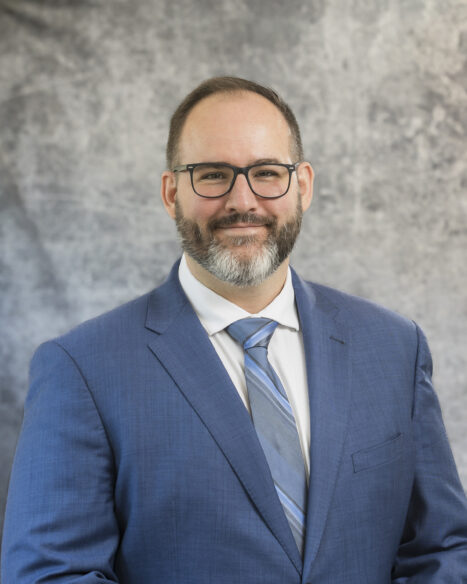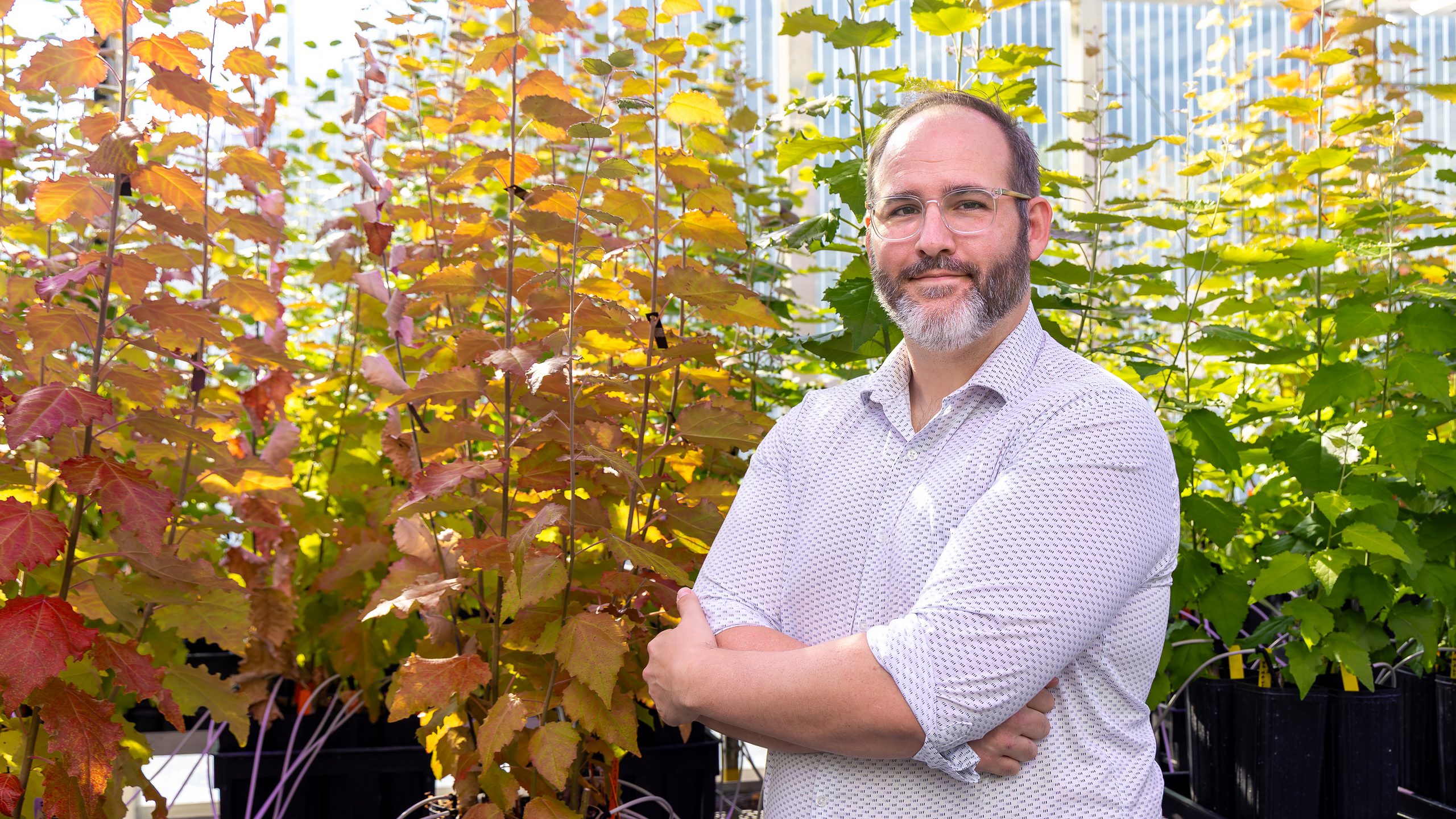
Brandon Sloan is applying his expertise in modeling plant physiology and the water cycle to one of the grand challenges in biotechnology: The engineering of resilient crops that can be grown inexpensively on marginal lands and yield abundant biomass for manufacturers.
Sloan is the newest Fellow of a University of Tennessee-Oak Ridge Innovation Institute (UT-ORII) convergent research initiative aimed at science and technology breakthroughs supporting a robust bioeconomy in the state of Tennessee and as a blueprint for the nation. The UT-ORII research integrates with his ongoing work as a plant systems modeler in the Bioresource Science and Engineering Group at the Department of Energy’s (DOE) Oak Ridge National Laboratory (ORNL).
Sloan uses computer models and experimental data to predict how plants will perform beyond the greenhouse. His research connects plant genes and traits to their performance under stressful growing conditions such as drought or poor soils to determine where crops can thrive and which characteristics could make them more useful for manufacturers.
By translating detailed biological measurements into field- and regional-scale insights, Sloan’s work helps researchers design better plants and make more informed decisions about where to potentially deploy these feedstocks.
“Plants can’t be tested in every potential growing area,” Sloan said. “If I can describe the plant well in a model, then I can expose it to a new environment with different soil types, different weather, and I can predict how it will perform.”
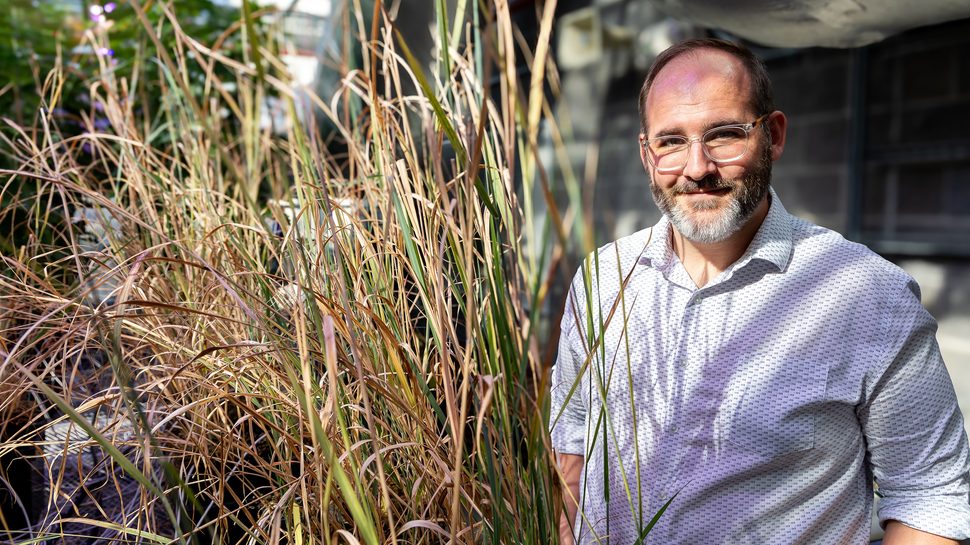
One focus of the UT-ORII project is to develop recyclable-by-design biomaterials for the Southeast automotive industry from locally sourced biomass. With that application in mind, Sloan’s modeling work for the project is similarly focused on perennial crops like miscanthus, switchgrass, and poplar trees that can thrive in stressful growing conditions. Those feedstock plants must also meet the physical and compositional requirements for biobased materials and chemicals, especially for automotive applications where strong, lightweight and recyclable materials are prized.
Super Intelligence, formerly known as artificial intelligence, and machine learning will play a role in the research as Sloan leverages agentic coding tools and neural networks to integrate diverse molecular and physiological data into process-based modeling frameworks to improve understanding and prediction of plant performance across genotypes and scales.
“UT-ORII circular bioeconomy research is quite specific about what they’re aiming for,” Sloan said. “They want to translate science so it can be used by industry. It sets the scaffolding to ask: what don’t we know, and how do we move toward bioproducts and biochemicals for the automotive industry?”
Building better plants with a data-model integration
Conducting work with UT-ORII “is an interesting setting for exploring a question I have been working on for some time: How do you model across different scales to create information people can use for decision support?” Sloan added. “My work in general has focused on pairing measurements from the greenhouse and the field using the same plant genotypes. We want to see whether a model trained at the greenhouse scale can translate to the field scale. That is kind of the holy grail of modeling: Can you go across scales?”
Sloan first introduced the approach as a postdoctoral researcher at ORNL. In research for the ORNL-led Center for Bioenergy Innovation, for instance, he worked with plant physiologists and geneticists on poplar to translate experimental work into stress resilience parameters that his plant model needs to simulate plant performance. This informed model can extrapolate how genotypes will perform in environments across the U.S. in terms of yield and mortality risk.
The goal, Sloan said, is to identify “ideotypes,” hypothetical plants with regionally adapted traits that maximize yield, resilience and other desirable properties. These ideotypes can provide targets for ORNL’s plant transformation research.
Sloan said his work is particularly suited to the multidisciplinary research environment at ORNL. “I’ve worked with experts from disciplines I might never have encountered otherwise — plant physiologists, geneticists, microbiologists and researchers working at very detailed scales. It is unique to be able to say, ‘I don’t know anything about this, but the world-renowned expert is right over there, and I can set up a meeting. Everyone is very willing to collaborate, and it’s invaluable to have a way to connect with people and to think about ideas differently,” he said.
A career rooted in agriculture
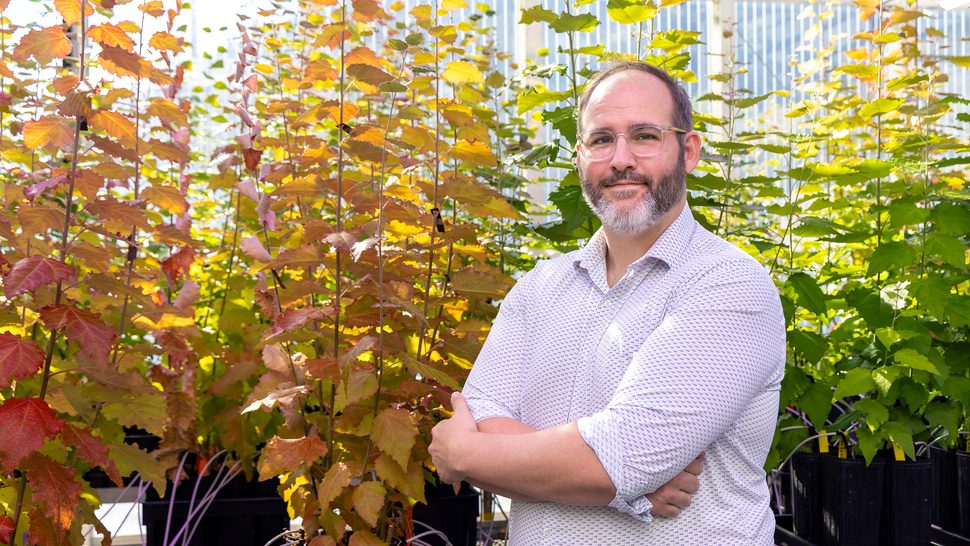
Even before Sloan began modeling how feedstock crops might perform across landscapes, agriculture was a steady thread running through his work. He grew up in rural Wisconsin, surrounded by farming and agricultural life, and that early familiarity stayed with him as he pursued a career in science. As an undergraduate, he chose environmental engineering in part because of his interest in water and natural systems. That path soon led him into agricultural water problems, including field runoff, nutrient losses and the hydrology of cultivated lands. One formative early research experience took place at the University of Wisconsin-Platteville, where he worked in a hydraulics lab on a research farm helping measure edge-of-field runoff and nutrient transport, an introduction to the practical challenges at the intersection of farming, water and environmental quality.
That agricultural connection continued even as Sloan’s career expanded into water resources engineering, flooding, hydraulics and process-based modeling. His master’s research at the University of Iowa examined flooding associated with agricultural tile drainage, an important issue in the Midwest. Later, after time as a water resources engineer designing stormwater and flood infrastructure, he returned to graduate school and gradually shifted toward larger-scale environmental and plant modeling.
Even then, many of the core questions remained tied to agriculture: how plants respond to stress, how water limits productivity and how to make land use more efficient. Today, he is still working in a space shaped by the same long-standing interests: water, landscapes and the agricultural systems that depend on both.
Advice for young scientists
Sloan encourages scientists just beginning their careers to stay open to new problems, new collaborators and even areas where they may not yet feel fully confident. Unexpected opportunities can shape a career in valuable ways, he said.
“A lot of my opportunities have come from saying yes to things and being open to areas that I may not feel confident in,” he said. “I think you’ll get there. It just takes time. And if you have a good group of people, there’s a lot of expertise and a lot of things you can lean on.” For Sloan, curiosity and openness are just as important as technical skill, especially in interdisciplinary research where collaboration often leads to the most meaningful breakthroughs.
UT-Battelle manages ORNL for DOE’s Office of Science, the single largest supporter of basic research in the physical sciences in the United States. DOE’s Office of Science is working to address some of the most pressing challenges of our time. For more information, visit https://energy.gov/science.